
Agent A 轉委派給 B 時,如何保留原始 User、限制 authority 並防止 privilege amplification?
Research Agent A 代表 Alice 找本季逾期客戶,將「只讀 customer_id 與 total_due、不得外送」的子任務交給 Report Agent B。若 A 直接把 Alice token 傳給 B,B 可能要求 write、讀取 payment_detail,甚至再轉交 C。A 需要建立的是一個比自己更窄、明確 audience 綁定 B 的新 delegation,而不是把原 Token 複製一份。
一般 service-to-service call 常只有 caller 與 callee;Multi-Agent 轉委派則要保留 Alice → A → B 的責任鏈,並讓每一跳都能驗證前一跳確實有權委派。Agent B 可能由不同團隊部署,且其輸出會改變下一步計畫,故 trust domain、depth 與不可再委派條件都必須進入 policy。
A 將 bearer User Token 放在 B 的 prompt 或 header。B 以同一 token 呼叫 write API,Tool 只看 sub=alice 而放行;事後 audit 看不到哪個 Agent 轉交,也無法判斷 B 是否超過 A 的 read-only task。這是 privilege amplification 與 accountability chain 遺失的組合失敗。
can_delegate。Alice → A → B,而不是只看 Alice。A 將收到的 User Token passthrough 給 B,B 自行宣稱 scope,Tool 只驗 issuer、subject 與 API scope;沒有 chain、audience、depth 或 non-escalation check。
A 向 delegation service 提出 exchange request,列出父 grant、B identity、目標 audience 與更窄 constraints。服務簽發新的 B grant;B 呼叫 Tool 時,PEP 驗證完整 chain、父子 scope 包含關係、expiry 與 can_delegate。
Alice/issuer、A runtime、delegation service、B runtime、Tool gateway 各自隔離。A 可以提出委派但不能簽發任意 authority;B 不能修改 chain 或刪除 actor history;Tool 不接受未經驗證的 X-Actor header。
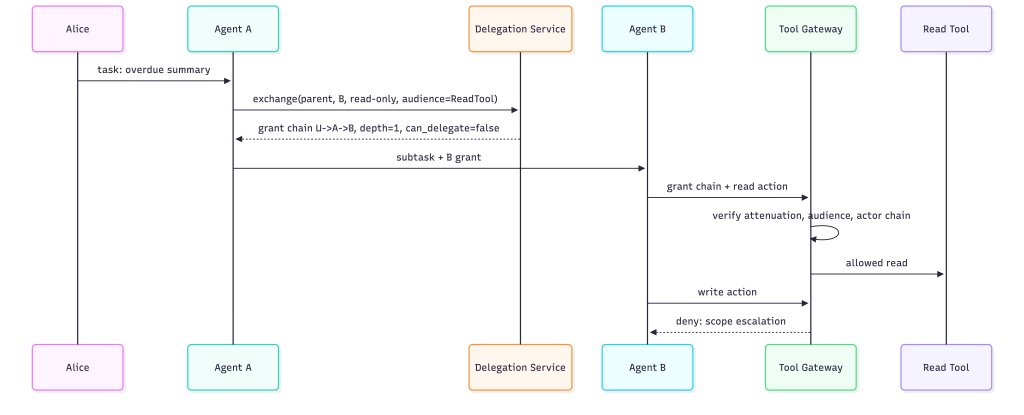
依 RFC 8693 的 token exchange 概念,交換不代表自動授權。PDP 要驗證 child.scope ⊆ parent.scope、child.audience 在父 grant allowlist、child.depth = parent.depth + 1、且 can_delegate=true。act/actor chain 可參考 RFC 8693 §4.1,但 chain retention 與業務 action 仍由本地 policy 決定。
parent = {"scope":{"read_customer"}, "aud":"report-b", "can_delegate":True, "depth":0}

def exchange(parent, child_scope, audience, can_delegate=False):
    if not child_scope.issubset(parent["scope"]): return None
    if audience != parent["aud"]: return None
    if not parent["can_delegate"]: return None
    return {"scope":child_scope, "aud":audience, "can_delegate":can_delegate,
            "depth":parent["depth"] + 1, "chain":"alice>A>B"}

child = exchange(parent, {"read_customer"}, "report-b")
assert child and child["depth"] == 1
assert exchange(parent, {"write_customer"}, "report-b") is None
assert exchange(child, {"read_customer"}, "tool-c") is None
print("attenuation and audience checks: PASS")
PoC 的第二、三個案例分別證明 privilege amplification 與錯誤 audience 會被拒絕;正式實作還要以簽章、issuer key rotation 與防 replay 儲存保護 grant。
can_delegate 都是決策輸入。Day 15 將處理 chain 的終點:哪些 audience、Action 或 trust domain 必須成為 terminal,讓 delegation 明確停止。



 iThome鐵人賽
 看影片追技術