
需求常常看到寫說,保護使用者輸入資料,避免個人相關資料PII外洩,那要如何建立防護控制呢,強度如何選擇呢
使用DAD(Disclosure–Alteration–Destruction),某種威脅或攻擊時,將其對應到它所針對的 CIA 元素。
| CIA 目標 | 反面 (DAD) | 重點 |
|---|---|---|
| 機密性 (Confidentiality) | 洩漏 (Disclosure) | 防止未經授權的資訊存取 |
| 完整性 (Integrity) | 竄改 (Alteration) | 防止未經授權的資料修改 |
| 可用性 (Availability) | 破壞 (Destruction) | 確保對資源的及時與可靠存取 |
資料敏感度分級與威脅對應
一般行政資料對於外洩衝擊與合規風險相對較低,主要威脅為傳輸過程的洩漏(Disclosure),因此落實標準 TLS 傳輸層加密來滿足基本機密性需求;刷卡與金流資料:涉及 PCI DSS 行規標準(最低要求為 AES-128)。然而綜合評估洩漏(Disclosure)的風險極高,因此採用 AES-256 進行靜態加密;更為了避免遭到竄改(Alteration),採用數位簽章來強化完整性防護。
| 資料分類 | 衝擊評估 | 威脅 | 控制措施 | 對應CIA |
|---|---|---|---|---|
| 一般行政資料 | 外洩衝擊相對較低 | 傳輸過程洩漏 (Disclosure) | 標準 TLS 傳輸層加密 | 機密性 (Confidentiality) |
| 刷卡與金流資料 | 合規衝擊極高 (PCI DSS 要求) | 靜態存儲洩漏 (Disclosure) 交易數據竄改 (Alteration) | AES-256加密 數位簽章 (Digital Signature) | 機密性 (Confidentiality) 完整性 (Integrity) |
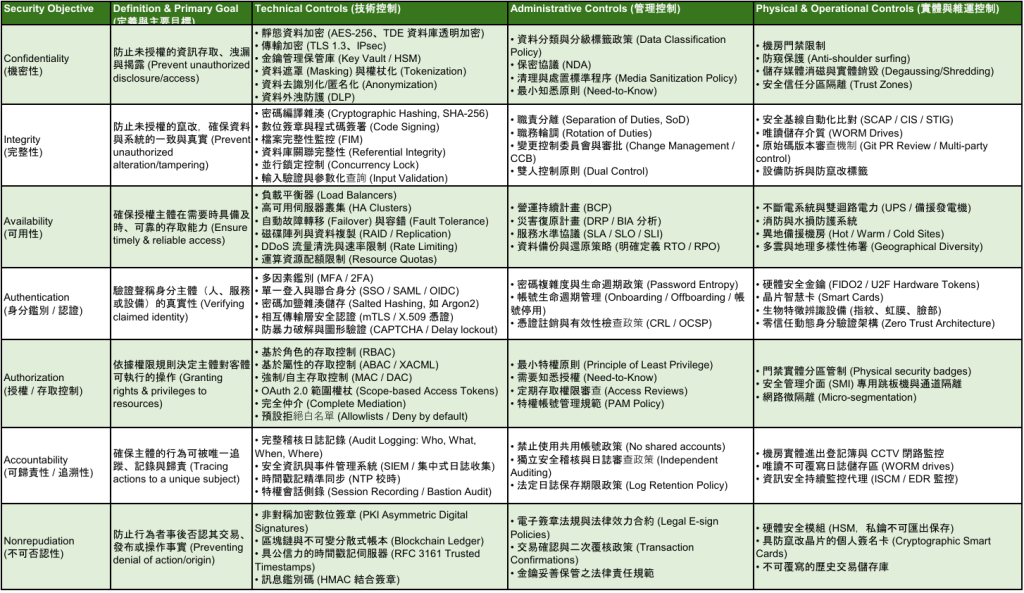
Preserving authorized restrictions on information access and disclosure, including means for protecting personal privacy and proprietary information. (FIPS 200 under CONFIDENTIALITY from 44 U.S.C., Sec. 3542)
| 機制 | 說明 |
|---|---|
| 加密 (Encryption) | 將資料轉換為密文;傳輸中與靜止中資料的主要保護方法 |
| 存取控制 (Access Controls) | 根據身分、角色或已知需求 (need-to-know) 限制存取 |
| 隱寫術 (Steganography) | 隱藏資訊的存在(例如:將資料隱藏在圖片像素中) |
| 數位浮水印 (Digital Watermarking) | 將識別資訊嵌入媒體內容中 |
| 匿名化 (Anonymization) | 從資料集中移除識別資訊 |
| 標記化 (Tokenization) | 使用非敏感的代碼 (token) 替換敏感資料 |
| 遮罩 (Masking) | 使用修改後的值替換資料(例如:****1234) |
(e.g., hashing, digital signatures, code signing, reliability, modifications, authenticity)
Guarding against improper information modification or destruction, and includes ensuring information nonrepudiation and authenticity.
data integrity (CSSLP著重Data層面)
A property whereby data has not been altered in an unauthorized manner since it was created, transmitted, or stored. (FIPS 200 under INTEGRITY from 44 U.S.C., Sec. 3542)
(e.g., redundancy, replication, clustering, scalability, resiliency)
Ensuring reliable and timely access to data and computing resources.
(e.g., multi-factor authentication (MFA), identity & access management (IAM), single sign-on (SSO), federated identity, biometrics)
The process of establishing with adequate certainty the identity of an entity.
(e.g., access controls, permissions, entitlements)
Confirming that an authenticated entity has the needed rights and privileges to access and perform actions on requested resources.
(e.g., auditing, logging)
The ability to determine the actions and behaviors of a subject within a system and identify that particular subject.
(e.g., digital signatures, block chain)
Protects against an individual falsely denying having performed a particular action.
(e.g., regulatory authority, legal, industry)
| 法規 | 重點 |
|---|---|
| HIPAA (1996) | 個人健康資訊 (PHI) 保護 |
| HITECH (2009) | 電子 PHI 記錄的增強隱私條款 |
| SOX (2002) | 上市公司財務報告完整性;第 302 條(公司責任)和第 404 條(內部控制評估) |
| GLBA | 保護消費者個人財務資訊 (PFI) |
| PCI DSS | 支付卡資料安全;合約性質,違反會有嚴重財務處罰 |
| FISMA (2002) | 聯邦機構全機構資訊安全計劃 |
| COPPA (1998) | 兒童線上隱私保護 |
| CCPA (2018) | 加州消費者隱私 |
ATT&CK Home
https://attack.mitre.org/resources/attack-data-and-tools/
D3FEND Resources
https://d3fend.mitre.org/resources/
NIST Glossary 名詞定義
https://csrc.nist.gov/glossary/



 iThome鐵人賽
 看影片追技術