
Day 20 已經能把九筆公開知識排出順序,但排序第一名仍不是答案。真正的檢索增強生成系統還要把取回內容交給生成模型,限制模型只能依證據作答,最後保存「取回了什麼、回答了什麼、引用了什麼」的完整紀錄。
如果直接把問題交給大型語言模型,回答可能很流暢,讀者卻無法知道內容來自哪一段公開規則。相反地,如果一次把九筆知識全部塞進提示詞,系統雖然看似「有用知識庫」,卻沒有建立可比較的檢索基準。今天先做最克制的一版:九筆知識全部放在同一層,只用語意向量的稠密檢索取前三筆,再交給固定的本機模型輸出結構化答案。
這條基準稱為平面式檢索增強生成(Flat Retrieval-Augmented Generation, Flat RAG):所有知識區塊位於同一層,不先經過父層路由。本文也會用 Flat Basic RAG 指稱今天這套只保留基本檢索與生成元件的實作。
下圖是概念示意。請先觀察左側九張卡仍在同一層,只有三張被搜尋光束選中;右側工作台代表本機生成步驟,不代表自動臨床判斷。

上圖要建立的直覺是「先找證據,再形成答案」。圖片沒有承載精確醫療規則;真正的文件數、前三筆證據、模型、欄位與驗證條件都由本文的設定檔和程式固定。
本篇只處理作者根據公開資料撰寫的六筆知識問題,不讀取 Kaggle 病患列、護理師登錄級數或專家重新判定級數。這是一個公開知識問答的工程整合測試,不是病患五級檢傷實驗,也不是臨床部署證據。
完成本篇後,你會得到五個可檢查的產物:
今天建立的是研究計畫中的 B5 平面稠密 RAG 基準。B4 無檢索生成、Day 20 的混合檢索與 Cohere 重排序,以及其他基準的配對比較,留到後續公平比較與消融實驗處理。
本篇同時跨越檢索、生成與輸出驗證,先用詞彙表建立共同語言。正文第一次出現時仍會重新解釋用途。
| 中文名稱 | 英文全名/縮寫 | 本篇用途 |
|---|---|---|
| 韓國急診檢傷與急迫度分級量表 | Korean Triage and Acuity Scale, KTAS | 本系列整理公開知識的五級檢傷制度;數字越小代表急迫度越高 |
| 大型語言模型 | Large Language Model, LLM | 根據前三筆公開證據產生答案;不能自行補齊知識缺口 |
| 檢索增強生成 | Retrieval-Augmented Generation, RAG | 先取回外部證據,再讓生成模型依證據回答 |
| 平面式檢索增強生成 | Flat Retrieval-Augmented Generation, Flat RAG | 把所有知識區塊放在同一層,直接做全域搜尋 |
| 稠密檢索 | Dense Retrieval | 用向量的整體語意相似度排列九筆知識 |
| 混合檢索 | Hybrid Retrieval | 合併語意與字詞檢索訊號;本篇刻意關閉 |
| 向量嵌入 | Vector Embedding | 把問題與文件轉成可比較的數字向量 |
| 餘弦相似度 | Cosine Similarity | 比較兩個向量方向是否接近,作為本篇排序分數 |
| 前 k 筆 | Top-k | 排序後保留的前 k 筆;本篇固定為 Top-3 |
| JavaScript 物件表示法 | JavaScript Object Notation, JSON | 保存設定、答案、公開摘要與執行紀錄的文字格式 |
| JSON 結構描述 | JSON Schema | 限定答案必須有哪些欄位與合法值 |
| 應用程式介面 | Application Programming Interface, API | 本機程式與 Ollama 交換請求與回應的規格 |
| 超文字傳輸協定 | Hypertext Transfer Protocol, HTTP | 本機 Ollama endpoint 使用的通訊協定 |
| 系統提示詞 | System Prompt | 告訴生成模型只能依 EVIDENCE 回答及何時回報證據不足 |
| 執行清單 | Run Manifest | 保存一次執行的時間、模型、參數、輸入與輸出雜湊 |
檢索增強生成(Retrieval-Augmented Generation, RAG)是一種先從外部知識庫取回相關證據,再讓大型語言模型(Large Language Model, LLM)依證據產生回答的方法。外部證據讓回答可以追查來源,但不保證模型一定正確使用證據。
平面式檢索增強生成(Flat Retrieval-Augmented Generation, Flat RAG)把每一筆知識視為同一層候選。它沒有先選父層主題,也沒有沿父子關係展開規則。今天的九筆文件包含 KTAS 制度目的、高階流程、主要與次要考量摘要,以及第一級到第五級的公開定義。
稠密檢索(Dense Retrieval)先用向量嵌入(Vector Embedding)把問題與文件轉成數字向量,再以餘弦相似度(Cosine Similarity)排序。餘弦相似度越大,代表兩個向量方向越接近;它只能表示模型眼中的語意接近程度,不是答案正確率、機率或醫療安全分數。
前 k 筆(Top-k)是排序後真正留下的前 k 筆候選。本篇固定 k=3,所以生成模型只會看到三筆公開摘要。上一步產生的完整九筆 Dense 排名會先被截成 Top-3;這三筆帶有 rule_id、相似度、來源與完整度,接著才被序列化成 EVIDENCE,成為生成步驟的輸入。
因為今天的目的不是把所有已完成元件一次接上,而是建立一條簡單、透明、可歸因的基準。若同時加入最佳匹配 25(Best Matching 25, BM25)、Hybrid、Cohere 重排序、階層結構與門控,之後看到結果改變時就無法知道是哪個元件造成差異。
B5 因此刻意固定:
| 元件 | Day 21 固定條件 | 理由 |
|---|---|---|
| 知識結構 | 九筆 flat chunks |
所有候選同層,作為 Day 22 的比較起點 |
| 查詢表示 | Day 18 的固定 query instruction | 不讓查詢改寫成為混雜因素 |
| 檢索器 | qwen3-embedding:4b 加 cosine |
只建立最基本的 Dense 排名 |
| context | Top-3 | 固定模型可見的證據數量 |
| 生成模型 | qwen3.5:4b-mlx |
後續有無檢索與架構比較共用同一模型 |
| 生成參數 | temperature=0、固定 seed、think=false |
降低非必要變異並不保存推理軌跡 |
| 輸出 | 每題專屬 JSON Schema | 讓級數題、文字題與缺口題有可驗證欄位 |
| 關閉元件 | hierarchy、BM25、reranker、retrieval gate | 保留基準的單純性 |
下圖把每一步的輸入與輸出放在同一條線上。請特別觀察底部四個關閉元件;Day 22 若要比較知識結構,應固定其他條件,只改平面與階層候選的組織方式。
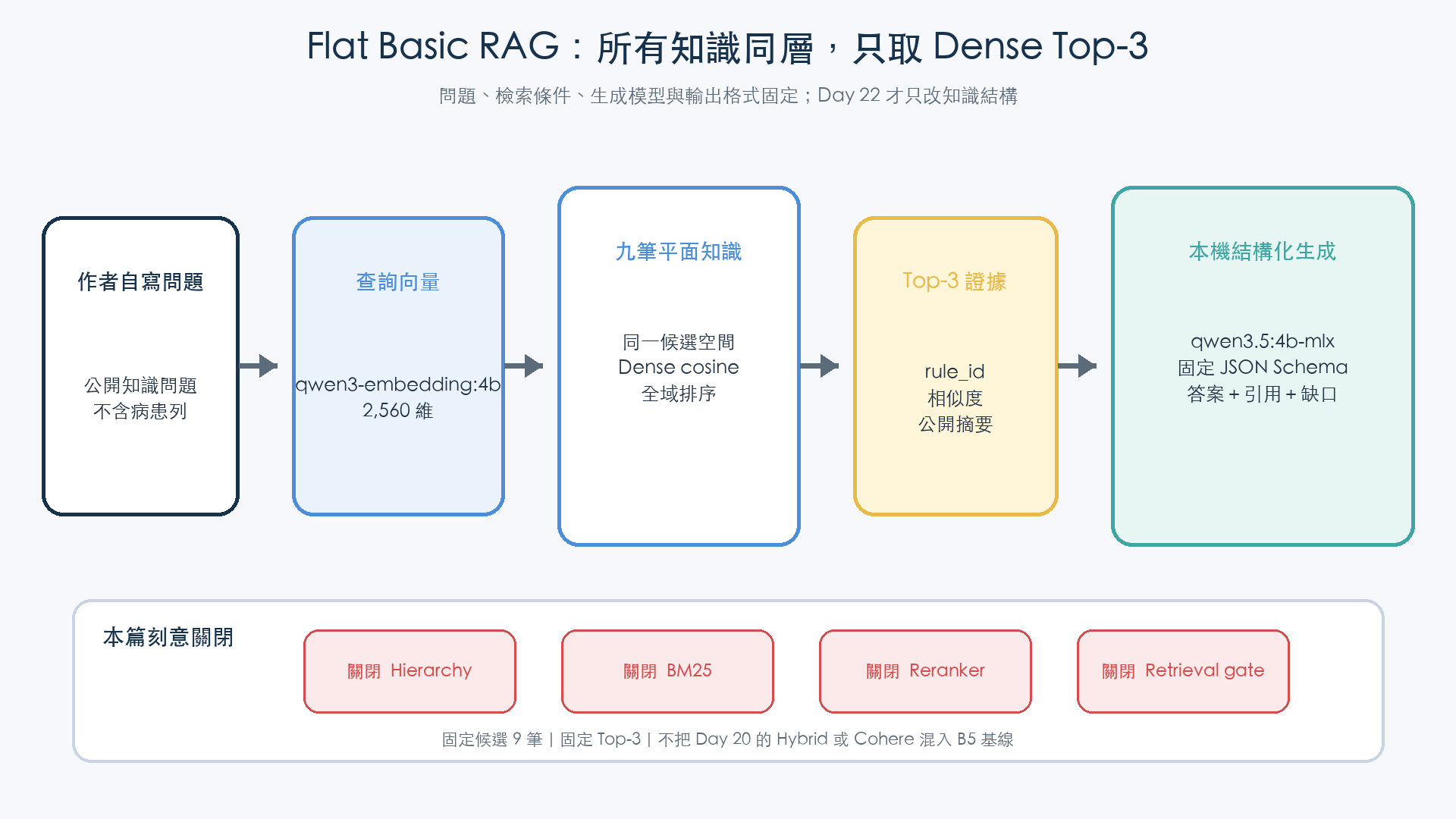
上圖也解釋了為什麼 Basic 不等於隨便:方法可以簡單,但每個輸入、關閉元件、模型與輸出都要明確。缺少這些固定條件的「簡單 RAG」不能成為公平基準。
韓國急診檢傷與急迫度分級量表(Korean Triage and Acuity Scale, KTAS)是五級檢傷制度。本系列目前整理的九筆內容只足以支援部分公開知識問題,沒有完整主訴目錄、各主訴的數值門檻與官方版本沿革。
因此 Day 21 不把病患主訴或生命徵象交給模型,也不要求模型替病患判定級數。六筆問題分成:
| 類型 | 數量 | 例子 | 固定預期 |
|---|---|---|---|
| 級數公開定義 | 2 | 哪一級僅次於第一級並需要快速治療? | supported,answer_level 為 1 到 5 |
| 一般公開知識 | 2 | 高階流程依序包含哪些步驟? | supported,answer_level=null |
| 已登錄知識缺口 | 2 | 請列出完整主訴數值門檻 | insufficient_evidence,answer_level=null |
四筆支援題都指定必要的 rule_id,讓程式檢查必要證據是否進入 Top-3,以及答案是否真的引用它。兩筆缺口題沒有必要規則;程式只檢查模型是否回報證據不足、級數為 null,並列出缺少資訊。
這個設計不能評估病患檢傷能力,卻能先回答三個工程問題:
應用程式介面(Application Programming Interface, API)是程式交換請求與回應的規格。本篇使用本機模型執行環境 Ollama 的 /api/chat 端點。Ollama 預設在 http://localhost:11434/api 提供本機介面;本篇程式只接受 127.0.0.1、localhost 或 ::1 的超文字傳輸協定(Hypertext Transfer Protocol, HTTP)endpoint,不允許把內容改送到遠端網址:Ollama API 簡介。
Ollama 的 Chat API 接收 model、messages、format、stream、think 與執行選項;format 可以直接放入 JSON Schema:Ollama Chat API。官方也建議除了把 schema 放在 format,同時在提示詞中提供 schema,並以較低溫度增加結構化輸出的穩定性:Ollama Structured Outputs。
JSON 結構描述(JSON Schema)在本篇負責限制七個欄位:
| 欄位 | 內容 | 自動檢查 |
|---|---|---|
case_id |
本次問題識別碼 | 必須等於目前案例 |
status |
supported 或 insufficient_evidence |
必須是固定列舉值 |
answer_level |
1 到 5 或 null |
級數題只能是 1–5;文字題與缺口題只能是 null |
answer_zh |
繁體中文答案 | 必須是非空字串 |
evidence_rule_ids |
實際支持回答的規則識別碼 | 不得出現 Top-3 之外的識別碼 |
missing_information |
證據不足時缺少的資訊 | 缺口題不可為空 |
safety_notice |
固定用途與限制文字 | 不能由模型自行改寫 |
題型 schema 只限制「級數題必須輸出某個 1 到 5」,不會把正確級數 2 或 4 注入模型。正確級數仍由模型根據 Top-3 證據產生,再由執行程式和預先固定的案例契約比較。
即使使用 JSON Schema,本機模型仍可能漏欄位或輸出不符合題型的值。本篇最多嘗試兩次:第一次失敗時,附加一段固定的七欄位提醒;第二次仍失敗就停止,不寫出一份假裝成功的公開結果。
這個修復流程只修正格式,不新增證據、不改問題,也不告訴模型正確答案。每一題的 attempt_count、是否啟動修復與第一次錯誤都會保存在結果中。
開始建立檔案前,先理解每個路徑負責什麼:
| 路徑 | 檔案類型與用途 | 輸入與輸出關係 |
|---|---|---|
configs/rag/ |
RAG 實驗 JSON 契約 | 保存上游雜湊、固定元件、案例與輸出路徑,供執行入口讀取 |
prompts/ |
純文字系統提示詞 | 成為 Ollama system message,不保存模型回應 |
src/triage_rag/generation/ |
可重用 Python 生成模組 | 呼叫本機 Ollama、檢查 runtime 與 JSON Schema |
src/triage_rag/rag/ |
可重用 Python RAG 模組 | 驗證平面候選、建立 Top-3 context 與答案檢查 |
scripts/ |
可直接執行的 Python 入口 | 串接設定、知識、embedding、generation 與輸出 |
tests/ |
Python 單元測試 | 使用合成或公開內容檢查失敗條件,不啟動模型 |
results/public/ |
可公開的 JSON 摘要 | 保存六筆公開問題、Top-3、答案與聚合檢查 |
results/runs/day-21/ |
每次執行的完整本機產物 | 保存完整結果與 run manifest,並由 .gitignore 排除 |
若只閱讀本篇但缺少前置產物,請先完成 Day 13 建立 Poetry 環境與重現性工具、Day 17 建立九筆 flat-chunks.jsonl,以及 Day 18 安裝 qwen3-embedding:4b 和 embedding 用戶端。以下完整檔案不需要從其他程式碼網站取得。
接下來不會要求你前往任何程式碼網站。請在自己的電腦開啟專案資料夾,依下列順序建立檔案;每個程式碼區塊都是該檔案的完整內容,不含省略號。
本篇沿用 Day 13 的 Poetry 與重現性工具、Day 17 的九筆 flat chunks、Day 18 的 qwen3-embedding:4b 與 Ollama embedding 用戶端,以及本機已下載的 qwen3.5:4b-mlx。六筆問題全部由作者根據公開知識與已登錄缺口撰寫,不讀取 Kaggle 病患列或參考標籤。以下是 Day 21 新增的完整契約、提示詞、本機生成用戶端、Flat RAG 核心、執行入口與測試;公開摘要、完整 trace 與 run manifest 都由執行入口自動產生,不需要手動建立。
先從專案根目錄建立需要的資料夾:
mkdir -p configs/rag prompts src/triage_rag/generation src/triage_rag/rag scripts tests results/public results/runs/day-21
如果指令沒有印出訊息是正常的。可用 test -d 資料夾路徑 && echo "資料夾已建立" 驗證單一資料夾。接著使用你熟悉的文字編輯器新增各檔案,把對應區塊完整貼入後儲存。
configs/rag/day-21-flat-basic-rag.json鎖定九筆平面候選、Dense Top-3、兩個本機模型 digest、生成參數、六筆公開問題、輸出與知識邊界。
請在文字編輯器建立 configs/rag/day-21-flat-basic-rag.json,貼入以下完整內容並儲存:
{
  "schema_version": 1,
  "experiment_id": "day-21-flat-basic-rag-public-knowledge",
  "scope": "author_written_public_knowledge_rag_integration_not_patient_triage_or_clinical_evaluation",
  "sources": {
    "flat_chunks_path": "data/knowledge/ktas-public-v1/day-17/flat-chunks.jsonl",
    "flat_chunks_sha256": "10749728567e36c565d9e2e0fb931c1ece7da448bd1c04f4527b624e8507a1fa",
    "embedding_config_path": "configs/representation/day-18-numeric-semantics.json",
    "embedding_config_sha256": "3d24a3688dbff4e617270f6fa9e953c055c835c4b0b10718eb6fa5a5ef3ada8b",
    "model_lock_path": "configs/models/local-ollama-model-lock.json",
    "model_lock_sha256": "0cd15cb4d7e735a19cbe439fe9a9344f717029694a4441764f67e396033cc7f4",
    "system_prompt_path": "prompts/day-21-flat-basic-rag-system.txt",
    "system_prompt_sha256": "e826351ce89d5a68427b42916b9f17d2f4931a886c71e6322dd5f7d508f55c27"
  },
  "baseline": {
    "baseline_id": "B5",
    "store_type": "flat",
    "retrieval_method": "dense_cosine",
    "top_k": 3,
    "expected_document_count": 9,
    "hierarchy_enabled": false,
    "bm25_enabled": false,
    "reranker_enabled": false,
    "retrieval_gate_enabled": false,
    "fixed_query_representation": "author_written_question_with_day18_dense_query_instruction",
    "comparison_policy": "Day 22 若比較階層結構,生成模型、問題、Top-3、提示詞與輸出 schema 必須固定。"
  },
  "generation": {
    "runtime": "Ollama",
    "endpoint": "http://127.0.0.1:11434",
    "model": "qwen3.5:4b-mlx",
    "expected_model_id_prefix": "61aa3858e9d3",
    "expected_model_digest": "61aa3858e9d3022e8fca725550089addd9289c4446f33bd09dfd12f95f2a6792",
    "expected_format": "safetensors",
    "expected_family": "qwen3_5",
    "expected_parameter_size": "4.5B",
    "expected_quantization_level": "nvfp4",
    "required_capabilities": ["completion"],
    "temperature": 0,
    "seed": 20260811,
    "num_predict": 512,
    "think": false,
    "stream": false,
    "keep_alive": "5m",
    "timeout_seconds": 300,
    "maximum_attempts": 2,
    "contract_repair_policy": "若第一次回應未通過 JSON Schema,附上固定的七欄位提醒後只重試一次;第二次仍失敗就停止且不寫公開結果。",
    "safety_notice": "研究與教學用途的決策支援示範,不提供個人醫療建議,也不取代醫療專業人員。"
  },
  "input_contract": {
    "expected_case_count": 6,
    "expected_supported_case_count": 4,
    "expected_gap_case_count": 2,
    "forbidden_fields": [
      "record_index",
      "KTAS_RN",
      "KTAS_expert",
      "Group",
      "diagnosis",
      "disposition",
      "length_of_stay",
      "Error_group",
      "mistriage"
    ]
  },
  "cases": [
    {
      "case_id": "supported-level-2",
      "question": "KTAS 哪一級僅次於第一級,代表生命、肢體或身體功能可能受到威脅,需要快速治療?",
      "answer_kind": "level",
      "expected_status": "supported",
      "expected_answer_level": 2,
      "required_evidence_rule_ids": ["ktas-public-level-2-001"],
      "origin": "author_written_from_public_knowledge_not_patient_record",
      "uses_patient_record": false,
      "uses_reference_label": false
    },
    {
      "case_id": "supported-level-4",
      "question": "KTAS 哪一級會依年齡、疼痛、惡化或併發症可能性,在一至兩小時內接受處置或重新評估?",
      "answer_kind": "level",
      "expected_status": "supported",
      "expected_answer_level": 4,
      "required_evidence_rule_ids": ["ktas-public-level-4-001"],
      "origin": "author_written_from_public_knowledge_not_patient_record",
      "uses_patient_record": false,
      "uses_reference_label": false
    },
    {
      "case_id": "supported-workflow",
      "question": "公開介紹中的 KTAS 高階檢傷流程依序包含哪些步驟?",
      "answer_kind": "text",
      "expected_status": "supported",
      "expected_answer_level": null,
      "required_evidence_rule_ids": ["ktas-public-workflow-001"],
      "origin": "author_written_from_public_knowledge_not_patient_record",
      "uses_patient_record": false,
      "uses_reference_label": false
    },
    {
      "case_id": "supported-primary-considerations",
      "question": "公開研究列出的 KTAS 共通主要考量類型有哪些?",
      "answer_kind": "text",
      "expected_status": "supported",
      "expected_answer_level": null,
      "required_evidence_rule_ids": ["ktas-public-primary-considerations-001"],
      "origin": "author_written_from_public_knowledge_not_patient_record",
      "uses_patient_record": false,
      "uses_reference_label": false
    },
    {
      "case_id": "gap-complete-thresholds",
      "question": "請提供每一個 KTAS 主訴可直接套用的完整數值門檻。",
      "answer_kind": "gap",
      "expected_status": "insufficient_evidence",
      "expected_answer_level": null,
      "required_evidence_rule_ids": [],
      "origin": "author_written_from_documented_knowledge_gap_not_patient_record",
      "uses_patient_record": false,
      "uses_reference_label": false
    },
    {
      "case_id": "gap-version-history",
      "question": "請根據目前知識庫列出完整官方版本編號、發布日期與逐版變更內容。",
      "answer_kind": "gap",
      "expected_status": "insufficient_evidence",
      "expected_answer_level": null,
      "required_evidence_rule_ids": [],
      "origin": "author_written_from_documented_knowledge_gap_not_patient_record",
      "uses_patient_record": false,
      "uses_reference_label": false
    }
  ],
  "outputs": {
    "public_summary_path": "results/public/day-21-flat-basic-rag.json",
    "run_output_root": "results/runs/day-21",
    "trace_case_id": "supported-level-2"
  },
  "limitations": [
    "六筆問題只驗證公開知識的端到端整合,不是病患五級檢傷評估。",
    "目前知識庫只有九筆公開摘要,沒有完整主訴目錄、逐主訴門檻或官方版本沿革。",
    "結構與字串檢查不能取代多位專家對答案語意、臨床正確性與安全性的審查。",
    "本篇只建立 B5 平面稠密 RAG;B4 無檢索生成與其他基準的配對比較留到 Day 26。"
  ]
}
儲存後先確認檔名與相對路徑完全一致,再繼續建立下一個檔案。
prompts/day-21-flat-basic-rag-system.txt要求生成模型只能依 EVIDENCE 回答,使用固定狀態、引用、缺口與安全說明欄位。
請在文字編輯器建立 prompts/day-21-flat-basic-rag-system.txt,貼入以下完整內容並儲存:
你是「公開 KTAS 知識問答」的研究與教學助理。KTAS 是韓國急診檢傷與急迫度分級量表(Korean Triage and Acuity Scale)。

你的唯一知識來源是使用者訊息中的 EVIDENCE。即使你記得其他資料,也不得使用模型既有知識補齊缺少的規則、數值門檻、主訴路徑或級數。

請遵守以下規則:

1. 先判斷 EVIDENCE 是否足以直接回答 QUESTION。
2. 若足以回答,status 使用 supported;answer_zh 只整理 EVIDENCE 已明確支持的內容,missing_information 必須是空陣列。
3. 若不足,status 使用 insufficient_evidence;answer_level 必須是 null,answer_zh 必須清楚指出目前證據不足,missing_information 必須列出缺少的知識或資訊。
4. 只有 QUESTION 明確詢問級數,而且 EVIDENCE 直接支持該級數時,answer_level 才能填入 1 到 5;一般制度、流程或考量問題一律填 null。
5. evidence_rule_ids 只能填入 EVIDENCE 中實際支持回答的 rule_id,不得虛構識別碼。沒有足以支持答案的證據時可使用空陣列。
6. 不得把一般級數定義套到個別案例,不得根據生命徵象自行猜測級數,也不得把部分公開摘要說成完整 KTAS 規則。級數的公開定義不等於主訴特定的數值門檻;若問題要求完整門檻,即使 EVIDENCE 出現部分級數定義,仍要指出缺少的是完整主訴目錄與各主訴的數值門檻,不能暗示已取得任何級數的完整門檻。
7. 這是研究與教學用途的決策支援示範,不提供個人醫療建議,也不取代醫療專業人員。
8. 每次都必須完整輸出 case_id、status、answer_level、answer_zh、evidence_rule_ids、missing_information 與 safety_notice 七個欄位;只輸出符合指定 JSON Schema 的 JSON 物件,不要加入 Markdown、程式碼圍欄或額外說明。
儲存後先確認檔名與相對路徑完全一致,再繼續建立下一個檔案。
src/triage_rag/generation/__init__.py建立本機文字生成子套件入口,公開 Ollama 錯誤、runtime 檢查、JSON Schema 與結構化生成函式。
請在文字編輯器建立 src/triage_rag/generation/__init__.py,貼入以下完整內容並儲存:
"""Local text generation clients used by the triage RAG experiments."""

from triage_rag.generation.ollama_chat import (
    OllamaChatError,
    build_response_schema,
    chat_structured,
    get_chat_runtime_metadata,
)

__all__ = [
    "OllamaChatError",
    "build_response_schema",
    "chat_structured",
    "get_chat_runtime_metadata",
]
儲存後先確認檔名與相對路徑完全一致,再繼續建立下一個檔案。
src/triage_rag/generation/ollama_chat.py實作只允許本機 HTTP endpoint 的 Ollama Chat 用戶端、模型資訊核對、逐題 JSON Schema 與回應驗證。
請在文字編輯器建立 src/triage_rag/generation/ollama_chat.py,貼入以下完整內容並儲存:
"""Minimal local Ollama chat client with JSON Schema validation."""

from __future__ import annotations

import json
from typing import Any, Dict, Mapping, Tuple
from urllib.error import HTTPError, URLError
from urllib.parse import urlparse
from urllib.request import Request, urlopen

from triage_rag.reproducibility import canonical_json_bytes


JsonObject = Dict[str, Any]


class OllamaChatError(RuntimeError):
    """Raised when the local Ollama chat service breaks the Day 21 contract."""


def _local_endpoint(endpoint: str) -> str:
    parsed = urlparse(endpoint)
    if parsed.scheme != "http" or parsed.hostname not in {
        "127.0.0.1",
        "localhost",
        "::1",
    }:
        raise OllamaChatError("Day 21 只允許本機 HTTP Ollama endpoint")
    return endpoint.rstrip("/")


def _request_json(
    endpoint: str,
    path: str,
    *,
    payload: Mapping[str, Any] | None = None,
    timeout_seconds: int = 300,
) -> JsonObject:
    base = _local_endpoint(endpoint)
    data = None if payload is None else canonical_json_bytes(payload)
    request = Request(
        base + path,
        data=data,
        method="GET" if data is None else "POST",
        headers={"Content-Type": "application/json"},
    )
    try:
        with urlopen(request, timeout=timeout_seconds) as response:
            body = response.read().decode("utf-8")
    except HTTPError as exc:
        detail = exc.read().decode("utf-8", errors="replace")
        raise OllamaChatError(
            f"Ollama 回傳 HTTP {exc.code}:{detail[:300]}"
        ) from exc
    except URLError as exc:
        raise OllamaChatError(
            "無法連線本機 Ollama;請先啟動 Ollama 並確認 11434 連接埠。"
        ) from exc
    try:
        value = json.loads(body)
    except json.JSONDecodeError as exc:
        raise OllamaChatError("Ollama 回應不是合法 JSON") from exc
    if not isinstance(value, dict):
        raise OllamaChatError("Ollama 回應必須是 JSON 物件")
    if value.get("error"):
        raise OllamaChatError(f"Ollama 錯誤:{value['error']}")
    return value


def get_chat_runtime_metadata(
    endpoint: str, model: str, *, timeout_seconds: int = 60
) -> JsonObject:
    """Read the installed tag digest and model capabilities without generating."""

    version = _request_json(
        endpoint, "/api/version", timeout_seconds=timeout_seconds
    ).get("version")
    if not isinstance(version, str) or not version.strip():
        raise OllamaChatError("/api/version 缺少有效的 version")
    tags = _request_json(endpoint, "/api/tags", timeout_seconds=timeout_seconds)
    models = tags.get("models")
    if not isinstance(models, list):
        raise OllamaChatError("/api/tags 缺少 models 陣列")
    matches = [
        item
        for item in models
        if item.get("name") == model or item.get("model") == model
    ]
    if len(matches) != 1:
        raise OllamaChatError(
            f"本機必須恰好存在一個 {model},目前找到 {len(matches)} 個"
        )
    tag = matches[0]
    show = _request_json(
        endpoint,
        "/api/show",
        payload={"model": model, "verbose": False},
        timeout_seconds=timeout_seconds,
    )
    details = show.get("details") or {}
    capabilities = show.get("capabilities")
    if not isinstance(capabilities, list) or "completion" not in capabilities:
        raise OllamaChatError(f"{model} 沒有回報 completion 能力")
    return {
        "ollama_version": version,
        "model": tag.get("name") or tag.get("model"),
        "digest": tag.get("digest"),
        "size_bytes": tag.get("size"),
        "format": details.get("format"),
        "family": details.get("family"),
        "parameter_size": details.get("parameter_size"),
        "quantization_level": details.get("quantization_level"),
        "capabilities": capabilities,
    }


def build_response_schema(
    case_id: str,
    safety_notice: str,
    *,
    answer_kind: str = "any",
) -> JsonObject:
    """Build a per-case schema so identifiers and the safety notice cannot drift."""

    answer_levels = {
        "any": [None, 1, 2, 3, 4, 5],
        "level": [1, 2, 3, 4, 5],
        "text": [None],
        "gap": [None],
    }
    if answer_kind not in answer_levels:
        raise OllamaChatError(f"不支援的 answer_kind:{answer_kind}")

    return {
        "type": "object",
        "additionalProperties": False,
        "required": [
            "case_id",
            "status",
            "answer_level",
            "answer_zh",
            "evidence_rule_ids",
            "missing_information",
            "safety_notice",
        ],
        "properties": {
            "case_id": {"type": "string", "enum": [case_id]},
            "status": {
                "type": "string",
                "enum": ["supported", "insufficient_evidence"],
            },
            "answer_level": {"enum": answer_levels[answer_kind]},
            "answer_zh": {"type": "string", "minLength": 1, "maxLength": 500},
            "evidence_rule_ids": {
                "type": "array",
                "items": {"type": "string", "minLength": 1},
                "uniqueItems": True,
                "maxItems": 3,
            },
            "missing_information": {
                "type": "array",
                "items": {"type": "string", "minLength": 1},
                "uniqueItems": True,
                "maxItems": 5,
            },
            "safety_notice": {"type": "string", "enum": [safety_notice]},
        },
    }


def _validate_structured_answer(
    answer: Mapping[str, Any], schema: Mapping[str, Any]
) -> None:
    properties = schema["properties"]
    required = set(schema["required"])
    if set(answer) != required:
        raise OllamaChatError(
            f"結構化答案欄位不同;預期 {sorted(required)},實際 {sorted(answer)}"
        )
    case_ids = properties["case_id"]["enum"]
    if answer["case_id"] not in case_ids:
        raise OllamaChatError("結構化答案 case_id 不符合本次問題")
    if answer["status"] not in properties["status"]["enum"]:
        raise OllamaChatError("結構化答案 status 不合法")
    if answer["answer_level"] not in properties["answer_level"]["enum"]:
        raise OllamaChatError(
            "answer_level 必須符合本題 schema:"
            f"{properties['answer_level']['enum']}"
        )
    if not isinstance(answer["answer_zh"], str) or not answer["answer_zh"].strip():
        raise OllamaChatError("answer_zh 必須是非空字串")
    for field, maximum in (("evidence_rule_ids", 3), ("missing_information", 5)):
        values = answer[field]
        if (
            not isinstance(values, list)
            or len(values) > maximum
            or len(values) != len(set(values))
            or any(not isinstance(value, str) or not value.strip() for value in values)
        ):
            raise OllamaChatError(f"{field} 必須是未重複的非空字串陣列")
    if answer["safety_notice"] not in properties["safety_notice"]["enum"]:
        raise OllamaChatError("safety_notice 不符合固定文字")


def chat_structured(
    *,
    system_prompt: str,
    user_message: str,
    schema: Mapping[str, Any],
    config: Mapping[str, Any],
) -> Tuple[JsonObject, JsonObject]:
    """Call non-streaming local chat and parse its schema-constrained JSON content."""

    if not system_prompt.strip() or not user_message.strip():
        raise OllamaChatError("system prompt 與 user message 都不可為空")
    schema_text = json.dumps(schema, ensure_ascii=False, sort_keys=True)
    payload = {
        "model": config["model"],
        "messages": [
            {
                "role": "system",
                "content": system_prompt + "\n\n本次輸出 JSON Schema:\n" + schema_text,
            },
            {"role": "user", "content": user_message},
        ],
        "stream": False,
        "format": dict(schema),
        "think": False,
        "keep_alive": config["keep_alive"],
        "options": {
            "temperature": config["temperature"],
            "seed": config["seed"],
            "num_predict": config["num_predict"],
        },
    }
    response = _request_json(
        config["endpoint"],
        "/api/chat",
        payload=payload,
        timeout_seconds=int(config["timeout_seconds"]),
    )
    if response.get("model") != config["model"]:
        raise OllamaChatError("Ollama 回應模型與設定不同")
    if response.get("done") is not True:
        raise OllamaChatError("非串流回應缺少 done=true")
    message = response.get("message")
    if not isinstance(message, dict) or not isinstance(message.get("content"), str):
        raise OllamaChatError("Ollama 回應缺少 message.content")
    if isinstance(message.get("thinking"), str) and message["thinking"].strip():
        raise OllamaChatError("Day 21 已設定 think=false,但回應仍包含 thinking")
    try:
        answer = json.loads(message["content"])
    except json.JSONDecodeError as exc:
        raise OllamaChatError("message.content 不是合法 JSON") from exc
    if not isinstance(answer, dict):
        raise OllamaChatError("message.content 必須解析為 JSON 物件")
    _validate_structured_answer(answer, schema)
    metrics = {
        "total_duration_ns": response.get("total_duration"),
        "load_duration_ns": response.get("load_duration"),
        "prompt_eval_count": response.get("prompt_eval_count"),
        "prompt_eval_duration_ns": response.get("prompt_eval_duration"),
        "eval_count": response.get("eval_count"),
        "eval_duration_ns": response.get("eval_duration"),
        "done_reason": response.get("done_reason"),
        "thinking_disabled": True,
        "streaming_disabled": True,
    }
    return dict(answer), metrics
儲存後先確認檔名與相對路徑完全一致,再繼續建立下一個檔案。
src/triage_rag/rag/__init__.py建立 RAG 子套件入口,公開 Flat baseline 的輸入、context、訊息與答案檢查函式。
請在文字編輯器建立 src/triage_rag/rag/__init__.py,貼入以下完整內容並儲存:
"""Retrieval-augmented generation pipelines."""

from triage_rag.rag.flat import (
    FlatRagContractError,
    build_context,
    build_user_message,
    evaluate_answer,
    validate_flat_contract,
    validate_public_cases,
)

__all__ = [
    "FlatRagContractError",
    "build_context",
    "build_user_message",
    "evaluate_answer",
    "validate_flat_contract",
    "validate_public_cases",
]
儲存後先確認檔名與相對路徑完全一致,再繼續建立下一個檔案。
src/triage_rag/rag/flat.py鎖定平面 Dense Top-3,阻擋病患欄位,建立可引用 context,並檢查狀態、級數、必要證據與引用集合。
請在文字編輯器建立 src/triage_rag/rag/flat.py,貼入以下完整內容並儲存:
"""Flat dense RAG baseline with explicit evidence and refusal checks."""

from __future__ import annotations

import json
from collections import Counter
from typing import Any, Dict, Iterable, List, Mapping, Sequence


JsonObject = Dict[str, Any]


class FlatRagContractError(ValueError):
    """Raised when inputs violate the fixed Day 21 baseline."""


def _all_keys(value: Any) -> Iterable[str]:
    if isinstance(value, Mapping):
        for key, child in value.items():
            yield str(key)
            yield from _all_keys(child)
    elif isinstance(value, list):
        for child in value:
            yield from _all_keys(child)


def validate_flat_contract(
    documents: Sequence[Mapping[str, Any]], config: Mapping[str, Any]
) -> JsonObject:
    baseline = config["baseline"]
    required = {
        "store_type": "flat",
        "retrieval_method": "dense_cosine",
        "top_k": 3,
        "hierarchy_enabled": False,
        "bm25_enabled": False,
        "reranker_enabled": False,
        "retrieval_gate_enabled": False,
    }
    mismatches = {
        key: {"actual": baseline.get(key), "expected": expected}
        for key, expected in required.items()
        if baseline.get(key) != expected
    }
    if mismatches:
        raise FlatRagContractError(f"Day 21 基線條件被改動:{mismatches}")
    expected_count = int(baseline["expected_document_count"])
    if len(documents) != expected_count:
        raise FlatRagContractError(
            f"平面知識候選應為 {expected_count} 筆,實際為 {len(documents)} 筆"
        )
    rule_ids = []
    for document in documents:
        if document.get("store_type") != "flat":
            raise FlatRagContractError("Day 21 只能讀取 flat chunks")
        if document.get("retrieval_role") != "search_candidate":
            raise FlatRagContractError("所有文件都必須是 search_candidate")
        metadata = document.get("metadata")
        if not isinstance(metadata, dict):
            raise FlatRagContractError("知識文件缺少 metadata")
        rule_id = metadata.get("rule_id")
        if not isinstance(rule_id, str) or not rule_id:
            raise FlatRagContractError("知識文件缺少 rule_id")
        if (
            not isinstance(document.get("search_text"), str)
            or not document["search_text"].strip()
        ):
            raise FlatRagContractError("知識文件缺少 search_text")
        rule_ids.append(rule_id)
    duplicates = sorted(
        rule_id for rule_id, count in Counter(rule_ids).items() if count > 1
    )
    if duplicates:
        raise FlatRagContractError(f"rule_id 不可重複:{duplicates}")
    return {
        "document_count": len(documents),
        "unique_rule_id_count": len(set(rule_ids)),
        "store_type": "flat",
        "top_k": 3,
        "disabled_components": [
            "hierarchy",
            "bm25",
            "reranker",
            "retrieval_gate",
        ],
    }


def validate_public_cases(
    cases: Sequence[Mapping[str, Any]],
    documents: Sequence[Mapping[str, Any]],
    config: Mapping[str, Any],
) -> JsonObject:
    """Reject patient fields and validate the fixed public integration cases."""

    contract = config["input_contract"]
    if not isinstance(cases, list):
        raise FlatRagContractError("Day 21 cases 必須是 JSON 陣列")
    if len(cases) != int(contract["expected_case_count"]):
        raise FlatRagContractError("Day 21 case 數量與契約不同")
    forbidden = set(contract["forbidden_fields"])
    present_forbidden = sorted(forbidden.intersection(_all_keys(cases)))
    if present_forbidden:
        raise FlatRagContractError(f"公開問題出現禁止欄位:{present_forbidden}")

    document_rule_ids = {
        str(document.get("metadata", {}).get("rule_id")) for document in documents
    }
    case_ids = []
    supported_count = 0
    gap_count = 0
    for case in cases:
        case_id = case.get("case_id")
        question = case.get("question")
        if not isinstance(case_id, str) or not case_id.strip():
            raise FlatRagContractError("case_id 必須是非空字串")
        if not isinstance(question, str) or not question.strip():
            raise FlatRagContractError(f"{case_id}.question 必須是非空字串")
        case_ids.append(case_id)
        if case.get("uses_patient_record") is not False:
            raise FlatRagContractError(f"{case_id} 不得使用病患紀錄")
        if case.get("uses_reference_label") is not False:
            raise FlatRagContractError(f"{case_id} 不得使用參考標籤")
        origin = case.get("origin")
        if not isinstance(origin, str) or "not_patient_record" not in origin:
            raise FlatRagContractError(f"{case_id}.origin 必須標示非病患紀錄")

        status = case.get("expected_status")
        answer_kind = case.get("answer_kind")
        level = case.get("expected_answer_level")
        required = case.get("required_evidence_rule_ids")
        if status not in {"supported", "insufficient_evidence"}:
            raise FlatRagContractError(f"{case_id}.expected_status 不支援")
        if answer_kind not in {"level", "text", "gap"}:
            raise FlatRagContractError(f"{case_id}.answer_kind 不支援")
        if level not in {None, 1, 2, 3, 4, 5}:
            raise FlatRagContractError(f"{case_id}.expected_answer_level 不合法")
        if (
            not isinstance(required, list)
            or len(required) != len(set(required))
            or any(not isinstance(rule_id, str) or not rule_id for rule_id in required)
        ):
            raise FlatRagContractError(
                f"{case_id}.required_evidence_rule_ids 格式錯誤"
            )
        unknown = sorted(set(required) - document_rule_ids)
        if unknown:
            raise FlatRagContractError(f"{case_id} 引用未知規則:{unknown}")
        if status == "supported":
            supported_count += 1
            if not required:
                raise FlatRagContractError(f"{case_id} 支援案例必須指定證據")
            if (answer_kind == "level") != (level is not None):
                raise FlatRagContractError(f"{case_id} 回答型別與預期級數不一致")
        else:
            gap_count += 1
            if answer_kind != "gap" or level is not None or required:
                raise FlatRagContractError(f"{case_id} 知識缺口契約不一致")

    duplicates = sorted(
        case_id
        for case_id, count in Counter(case_ids).items()
        if count > 1
    )
    if duplicates:
        raise FlatRagContractError(f"case_id 不可重複:{duplicates}")
    if supported_count != int(contract["expected_supported_case_count"]):
        raise FlatRagContractError("supported case 數量與契約不同")
    if gap_count != int(contract["expected_gap_case_count"]):
        raise FlatRagContractError("gap case 數量與契約不同")
    return {
        "case_count": len(cases),
        "supported_case_count": supported_count,
        "gap_case_count": gap_count,
        "forbidden_fields_absent": True,
        "patient_records_used": False,
        "reference_labels_used": False,
    }


def build_context(
    ranking: Sequence[Mapping[str, Any]],
    document_by_rule: Mapping[str, Mapping[str, Any]],
    *,
    top_k: int,
) -> List[JsonObject]:
    """Turn top-ranked flat chunks into the only evidence visible to the model."""

    if top_k != 3:
        raise FlatRagContractError("Day 21 固定使用 Top-3")
    if len(ranking) < top_k:
        raise FlatRagContractError("排名筆數少於 Top-3")
    context = []
    for item in ranking[:top_k]:
        rule_id = item.get("rule_id")
        if rule_id not in document_by_rule:
            raise FlatRagContractError(f"排名出現未知 rule_id:{rule_id}")
        document = document_by_rule[str(rule_id)]
        metadata = document["metadata"]
        context.append(
            {
                "rank": len(context) + 1,
                "rule_id": rule_id,
                "topic": metadata["topic"],
                "completeness": metadata["completeness"],
                "source_id": metadata["source_id"],
                "source_url": metadata["source_url"],
                "cosine_similarity": round(float(item["cosine_similarity"]), 8),
                "text": document["search_text"],
            }
        )
    return context


def build_user_message(
    case_id: str,
    question: str,
    context: Sequence[Mapping[str, Any]],
) -> str:
    if not case_id.strip() or not question.strip():
        raise FlatRagContractError("case_id 與 question 都不可為空")
    evidence = json.dumps(list(context), ensure_ascii=False, sort_keys=True, indent=2)
    return (
        f"CASE_ID:\n{case_id}\n\n"
        f"QUESTION:\n{question}\n\n"
        f"EVIDENCE:\n{evidence}"
    )


def evaluate_answer(
    answer: Mapping[str, Any],
    case_contract: Mapping[str, Any],
    context: Sequence[Mapping[str, Any]],
    *,
    safety_notice: str,
) -> JsonObject:
    """Evaluate observable grounding behavior without pretending to judge all semantics."""

    retrieved = [str(item["rule_id"]) for item in context]
    cited = answer.get("evidence_rule_ids")
    cited_list = cited if isinstance(cited, list) else []
    required = list(case_contract.get("required_evidence_rule_ids", []))
    expected_level = case_contract.get("expected_answer_level")
    checks = {
        "case_id_matches": answer.get("case_id") == case_contract["case_id"],
        "status_matches_expected": answer.get("status")
        == case_contract["expected_status"],
        "answer_level_matches_expected": answer.get("answer_level")
        == expected_level,
        "citations_are_retrieved": set(cited_list).issubset(retrieved),
        "required_evidence_was_retrieved": set(required).issubset(retrieved),
        "required_evidence_was_cited": set(required).issubset(cited_list),
        "insufficient_answer_has_no_level": not (
            answer.get("status") == "insufficient_evidence"
            and answer.get("answer_level") is not None
        ),
        "insufficient_answer_lists_missing_information": not (
            answer.get("status") == "insufficient_evidence"
            and not answer.get("missing_information")
        ),
        "supported_answer_cites_evidence": not (
            answer.get("status") == "supported" and not cited_list
        ),
        "supported_answer_has_no_missing_information": not (
            answer.get("status") == "supported"
            and bool(answer.get("missing_information"))
        ),
        "safety_notice_matches": answer.get("safety_notice") == safety_notice,
    }
    return {
        "checks": checks,
        "passed": all(checks.values()),
        "validation_boundary": (
            "只驗證結構、預期狀態、級數、檢索命中與引用集合;"
            "不把字串檢查宣稱為完整醫療正確性驗證。"
        ),
    }
儲存後先確認檔名與相對路徑完全一致,再繼續建立下一個檔案。
scripts/run_day21_flat_basic_rag.py驗證來源與模型、建立向量、逐題檢索與生成、執行固定一次的 schema 修復,最後寫出公開摘要與 run manifest。
請在文字編輯器建立 scripts/run_day21_flat_basic_rag.py,貼入以下完整內容並儲存:
#!/usr/bin/env python3
"""Run the Day 21 flat dense RAG baseline on public KTAS knowledge."""

from __future__ import annotations

import argparse
import platform
import sys
from datetime import datetime, timezone
from pathlib import Path
from typing import Any, Dict, List, Mapping

from triage_rag.generation import (
    OllamaChatError,
    build_response_schema,
    chat_structured,
    get_chat_runtime_metadata,
)
from triage_rag.knowledge_base.builder import read_jsonl
from triage_rag.rag import (
    build_context,
    build_user_message,
    evaluate_answer,
    validate_flat_contract,
    validate_public_cases,
)
from triage_rag.representation.embedding import (
    embed_texts,
    get_runtime_metadata,
    rank_documents,
    vector_sha256,
)
from triage_rag.reproducibility import (
    file_record,
    git_state,
    load_json,
    resolve_project_path,
    sha256_file,
    write_json,
)


PROJECT_ROOT = Path(__file__).resolve().parents[1]
DEFAULT_CONFIG = "configs/rag/day-21-flat-basic-rag.json"
IMPLEMENTATION_PATHS = (
    "scripts/run_day21_flat_basic_rag.py",
    "src/triage_rag/generation/__init__.py",
    "src/triage_rag/generation/ollama_chat.py",
    "src/triage_rag/rag/__init__.py",
    "src/triage_rag/rag/flat.py",
    "src/triage_rag/representation/embedding.py",
    "src/triage_rag/reproducibility.py",
)
JsonObject = Dict[str, Any]


def parse_args() -> argparse.Namespace:
    parser = argparse.ArgumentParser(
        description="以九筆公開 KTAS 平面知識執行 Dense Top-3 與本機結構化生成。"
    )
    parser.add_argument("--config", default=DEFAULT_CONFIG)
    return parser.parse_args()


def _verify_sha256(path: Path, expected: str, label: str) -> None:
    actual = sha256_file(path)
    if actual != expected:
        raise ValueError(
            f"{label} SHA-256 不同;預期 {expected},實際 {actual}。"
            "請先重建上游產物,或建立新版 Day 21 契約。"
        )


def _verify_sources(config: Mapping[str, Any]) -> List[Path]:
    sources = config["sources"]
    pairs = [
        ("flat_chunks_path", "flat_chunks_sha256", "Day 17 flat chunks"),
        (
            "embedding_config_path",
            "embedding_config_sha256",
            "Day 18 embedding 設定",
        ),
        ("model_lock_path", "model_lock_sha256", "本機模型鎖定"),
        ("system_prompt_path", "system_prompt_sha256", "Day 21 system prompt"),
    ]
    paths = []
    for path_key, hash_key, label in pairs:
        path = resolve_project_path(PROJECT_ROOT, str(sources[path_key]))
        _verify_sha256(path, str(sources[hash_key]), label)
        paths.append(path)
    return paths


def _verify_embedding_runtime(
    runtime: Mapping[str, Any],
    embedding: Mapping[str, Any],
    model_lock: Mapping[str, Any],
) -> None:
    dense_lock = model_lock["models"]["dense_embedding"]
    checks = {
        "lock_name": (dense_lock.get("name"), embedding["model"]),
        "lock_id": (
            dense_lock.get("model_id"),
            embedding["expected_model_id_prefix"],
        ),
        "runtime_name": (runtime.get("model"), embedding["model"]),
        "runtime_digest": (
            runtime.get("digest"),
            embedding["expected_model_digest"],
        ),
        "parameter_size": (
            runtime.get("parameter_size"),
            embedding["expected_parameter_size"],
        ),
        "quantization_level": (
            runtime.get("quantization_level"),
            embedding["expected_quantization_level"],
        ),
    }
    mismatches = {
        name: {"actual": actual, "expected": expected}
        for name, (actual, expected) in checks.items()
        if actual != expected
    }
    if mismatches:
        raise ValueError(f"本機 embedding 模型與 Day 21 契約不同:{mismatches}")


def _verify_generator_runtime(
    runtime: Mapping[str, Any],
    generation: Mapping[str, Any],
    model_lock: Mapping[str, Any],
) -> None:
    generator_lock = model_lock["models"]["primary_generator"]
    required_capabilities = set(generation["required_capabilities"])
    runtime_capabilities = set(runtime.get("capabilities") or [])
    checks = {
        "lock_name": (generator_lock.get("name"), generation["model"]),
        "lock_id": (
            generator_lock.get("model_id"),
            generation["expected_model_id_prefix"],
        ),
        "runtime_name": (runtime.get("model"), generation["model"]),
        "runtime_digest": (
            runtime.get("digest"),
            generation["expected_model_digest"],
        ),
        "format": (runtime.get("format"), generation["expected_format"]),
        "family": (runtime.get("family"), generation["expected_family"]),
        "parameter_size": (
            runtime.get("parameter_size"),
            generation["expected_parameter_size"],
        ),
        "quantization_level": (
            runtime.get("quantization_level"),
            generation["expected_quantization_level"],
        ),
    }
    mismatches = {
        name: {"actual": actual, "expected": expected}
        for name, (actual, expected) in checks.items()
        if actual != expected
    }
    if not required_capabilities.issubset(runtime_capabilities):
        mismatches["capabilities"] = {
            "actual": sorted(runtime_capabilities),
            "expected_at_least": sorted(required_capabilities),
        }
    if mismatches:
        raise ValueError(f"本機生成模型與 Day 21 契約不同:{mismatches}")


def _round_floats(value: Any) -> Any:
    if isinstance(value, float):
        return round(value, 8)
    if isinstance(value, dict):
        return {key: _round_floats(child) for key, child in value.items()}
    if isinstance(value, list):
        return [_round_floats(child) for child in value]
    return value


def _aggregate(case_results: List[JsonObject]) -> JsonObject:
    supported = [
        item for item in case_results if item["expected_status"] == "supported"
    ]
    gaps = [
        item
        for item in case_results
        if item["expected_status"] == "insufficient_evidence"
    ]
    checks = [item["evaluation"]["checks"] for item in case_results]
    supported_checks = [item["evaluation"]["checks"] for item in supported]
    return {
        "case_count": len(case_results),
        "passed_case_count": sum(item["evaluation"]["passed"] for item in case_results),
        "supported_case_count": len(supported),
        "supported_status_match_count": sum(
            item["answer"]["status"] == "supported" for item in supported
        ),
        "gap_case_count": len(gaps),
        "gap_refusal_count": sum(
            item["answer"]["status"] == "insufficient_evidence" for item in gaps
        ),
        "required_evidence_case_count": len(supported),
        "required_evidence_retrieval_hit_count": sum(
            check["required_evidence_was_retrieved"] for check in supported_checks
        ),
        "required_evidence_citation_hit_count": sum(
            check["required_evidence_was_cited"] for check in supported_checks
        ),
        "citation_subset_pass_count": sum(
            check["citations_are_retrieved"] for check in checks
        ),
        "all_cases_passed": all(item["evaluation"]["passed"] for item in case_results),
    }


def _generate_with_contract_repair(
    *,
    system_prompt: str,
    user_message: str,
    schema: Mapping[str, Any],
    generation: Mapping[str, Any],
) -> tuple[JsonObject, JsonObject]:
    """Retry once with a fixed reminder when local output breaks the schema."""

    maximum_attempts = int(generation["maximum_attempts"])
    if maximum_attempts != 2:
        raise ValueError("Day 21 固定只允許兩次結構化生成嘗試")
    repair_note = (
        "\n\n前一次輸出未通過固定 JSON Schema。請重新檢查,且只輸出包含 "
        "case_id、status、answer_level、answer_zh、evidence_rule_ids、"
        "missing_information、safety_notice 七個欄位的 JSON 物件。"
    )
    first_error = None
    for attempt in range(1, maximum_attempts + 1):
        message = user_message if attempt == 1 else user_message + repair_note
        try:
            answer, metrics = chat_structured(
                system_prompt=system_prompt,
                user_message=message,
                schema=schema,
                config=generation,
            )
        except OllamaChatError as exc:
            if attempt == maximum_attempts:
                raise
            first_error = str(exc)
            continue
        return answer, {
            **metrics,
            "attempt_count": attempt,
            "contract_repair_triggered": attempt > 1,
            "first_attempt_error": first_error,
        }
    raise AssertionError("unreachable")


def main() -> int:
    args = parse_args()
    started_at = datetime.now(timezone.utc)
    config_path = resolve_project_path(PROJECT_ROOT, args.config)
    config = load_json(config_path)
    if config.get("schema_version") != 1:
        raise ValueError("目前只支援 schema_version=1")
    if config.get("scope") != (
        "author_written_public_knowledge_rag_integration_not_patient_triage_or_clinical_evaluation"
    ):
        raise ValueError("Day 21 scope 不正確")
    source_paths = _verify_sources(config)

    sources = config["sources"]
    documents = read_jsonl(
        resolve_project_path(PROJECT_ROOT, sources["flat_chunks_path"])
    )
    flat_contract = validate_flat_contract(documents, config)
    cases = list(config["cases"])
    case_contract = validate_public_cases(cases, documents, config)

    embedding_config = load_json(
        resolve_project_path(PROJECT_ROOT, sources["embedding_config_path"])
    )
    embedding = embedding_config["embedding"]
    generation = config["generation"]
    model_lock = load_json(
        resolve_project_path(PROJECT_ROOT, sources["model_lock_path"])
    )
    system_prompt = resolve_project_path(
        PROJECT_ROOT, sources["system_prompt_path"]
    ).read_text(encoding="utf-8")

    print("步驟 1/4:驗證平面知識、六筆公開問題與兩個本機模型。", flush=True)
    embedding_runtime = get_runtime_metadata(
        embedding["endpoint"],
        embedding["model"],
        timeout_seconds=int(embedding["timeout_seconds"]),
    )
    generator_runtime = get_chat_runtime_metadata(
        generation["endpoint"],
        generation["model"],
        timeout_seconds=int(generation["timeout_seconds"]),
    )
    _verify_embedding_runtime(embedding_runtime, embedding, model_lock)
    _verify_generator_runtime(generator_runtime, generation, model_lock)

    print("步驟 2/4:建立九筆文件向量與六筆查詢向量。", flush=True)
    document_vectors, document_embedding_metrics = embed_texts(
        [item["search_text"] for item in documents], embedding
    )
    query_inputs = [
        f"Instruct: {embedding['query_instruction']}\nQuery: {case['question']}"
        for case in cases
    ]
    query_vectors, query_embedding_metrics = embed_texts(query_inputs, embedding)
    document_by_rule = {
        item["metadata"]["rule_id"]: item for item in documents
    }

    print("步驟 3/4:逐題執行 Dense Top-3、結構化生成與可觀察檢查。", flush=True)
    case_results = []
    for index, (case, query_vector) in enumerate(
        zip(cases, query_vectors), start=1
    ):
        ranking = rank_documents(query_vector, documents, document_vectors)
        context = build_context(
            ranking,
            document_by_rule,
            top_k=int(config["baseline"]["top_k"]),
        )
        schema = build_response_schema(
            case["case_id"],
            generation["safety_notice"],
            answer_kind=case["answer_kind"],
        )
        answer, generation_metrics = _generate_with_contract_repair(
            system_prompt=system_prompt,
            user_message=build_user_message(
                case["case_id"], case["question"], context
            ),
            schema=schema,
            generation=generation,
        )
        evaluation = evaluate_answer(
            answer,
            case,
            context,
            safety_notice=generation["safety_notice"],
        )
        case_results.append(
            {
                "case_id": case["case_id"],
                "question": case["question"],
                "answer_kind": case["answer_kind"],
                "expected_status": case["expected_status"],
                "expected_answer_level": case["expected_answer_level"],
                "required_evidence_rule_ids": case["required_evidence_rule_ids"],
                "query_vector_sha256": vector_sha256(query_vector),
                "retrieved_context": context,
                "answer": answer,
                "evaluation": evaluation,
                "generation_metrics": generation_metrics,
            }
        )
        state = "通過" if evaluation["passed"] else "未通過"
        print(f"  {index:02d}/06 {case['case_id']}:{state}", flush=True)

    aggregate = _aggregate(case_results)
    run_id = (
        f"{started_at.strftime('%Y%m%dT%H%M%S%fZ')}-"
        f"{sha256_file(config_path)[:8]}"
    )
    run_root = resolve_project_path(
        PROJECT_ROOT, config["outputs"]["run_output_root"]
    )
    run_directory = run_root / run_id
    run_directory.mkdir(parents=True, exist_ok=False)
    full_results_path = run_directory / "flat-basic-rag-results.json"

    full_results = {
        "schema_version": 1,
        "experiment_id": config["experiment_id"],
        "scope": config["scope"],
        "aggregate": aggregate,
        "case_results": _round_floats(case_results),
    }
    write_json(full_results_path, full_results)

    trace_case_id = config["outputs"]["trace_case_id"]
    trace = next(
        item for item in case_results if item["case_id"] == trace_case_id
    )
    public_summary = {
        "schema_version": 1,
        "experiment_id": config["experiment_id"],
        "scope": config["scope"],
        "baseline_contract": config["baseline"],
        "input_contract": {**flat_contract, **case_contract},
        "runtime": {
            "embedding": embedding_runtime,
            "generator": generator_runtime,
        },
        "parameters": {
            "embedding_model": embedding["model"],
            "embedding_dimensions": embedding["dimensions"],
            "query_instruction": embedding["query_instruction"],
            "generator_model": generation["model"],
            "temperature": generation["temperature"],
            "seed": generation["seed"],
            "think": generation["think"],
            "stream": generation["stream"],
            "structured_output": "per_case_json_schema",
        },
        "aggregate": aggregate,
        "case_results": _round_floats(case_results),
        "trace_case": _round_floats(trace),
        "checks": {
            "source_hashes_match": True,
            "flat_nine_document_candidate_space": True,
            "dense_top3_only": True,
            "hierarchy_bm25_reranker_and_gate_disabled": True,
            "embedding_and_generator_locks_match_runtime": True,
            "only_author_written_public_knowledge_questions_used": True,
            "patient_rows_and_reference_labels_not_read": True,
            "structured_answers_validated_before_writing": True,
        },
        "limitations": config["limitations"],
        "interpretation": (
            "六筆公開知識整合案例的可觀察檢查;不是病患五級分類、"
            "模型效能比較、臨床正確性或部署安全證據。"
        ),
    }
    public_path = resolve_project_path(
        PROJECT_ROOT, config["outputs"]["public_summary_path"]
    )
    write_json(public_path, public_summary)

    manifest = {
        "manifest_schema_version": 1,
        "run_id": run_id,
        "experiment_id": config["experiment_id"],
        "started_at_utc": started_at.isoformat().replace("+00:00", "Z"),
        "command": [sys.executable, str(Path(__file__).relative_to(PROJECT_ROOT)), "--config", args.config],
        "git": git_state(PROJECT_ROOT),
        "runtime": {
            "python": platform.python_version(),
            "embedding": embedding_runtime,
            "generator": generator_runtime,
        },
        "parameters": public_summary["parameters"],
        "inputs": [
            file_record(PROJECT_ROOT, args.config),
            *[
                file_record(PROJECT_ROOT, str(path.relative_to(PROJECT_ROOT)))
                for path in source_paths
            ],
            *[file_record(PROJECT_ROOT, path) for path in IMPLEMENTATION_PATHS],
        ],
        "embedding_metrics": {
            "documents": document_embedding_metrics,
            "queries": query_embedding_metrics,
            "document_vector_sha256": {
                document["metadata"]["rule_id"]: vector_sha256(vector)
                for document, vector in zip(documents, document_vectors)
            },
        },
        "outputs": [
            file_record(PROJECT_ROOT, str(full_results_path.relative_to(PROJECT_ROOT))),
            file_record(PROJECT_ROOT, str(public_path.relative_to(PROJECT_ROOT))),
        ],
        "scope": config["scope"],
    }
    manifest_path = run_directory / "run-manifest.json"
    write_json(manife



 iThome鐵人賽
 看影片追技術