
針對 Day 26 案例 B 揭示的「邊界樣本因特徵正負拉扯、在固定 0.33 均分門檻下保守退化為中度風險」的痛點,結合演算法融合與決策後處理技術。首先將表現最優異的 LightGBM(冠軍) 與穩定度最佳的 隨機森林優化版(亞軍) 透過軟投票集成進行預測機率平滑融合;接著實施針對「高度疲勞風險」的動態分類門檻移動,全面壓榨模型在高風險篩檢上的邊際效能。
一、實作前情境:為什麼需要軟投票與門檻移動?
在經過 Day 19 至 Day 26 的系列實驗後,我們獲得了兩項關鍵認知:
單一模型的決策盲區:
隨機森林優化版:具備最高的排序穩定度(Macro ROC-AUC = 0.553),但樹深限制使其在高風險的機率輸出較為保守。
LightGBM:擁有最強的三類別平衡度(Macro F1 = 0.417)與高風險召回(11 筆),但單一葉節點生長容易受特定自覺評分雜訊干擾(如案例 B 呈現的拉扯)。
2.預設 Argmax 門檻(1/3)的臨床局限:在三分類任務中,predict()
二、撰寫軟投票集成與動態門檻調優腳本
在 Colab 中新增儲存格,使用 scikit-learn 建構 VotingClassifier 並搜尋最佳高風險判定門檻:
# ==========================================
# Day 27:軟投票集成與高風險動態門檻
# ==========================================

import warnings
warnings.filterwarnings('ignore')

import matplotlib.pyplot as plt
import seaborn as sns
import matplotlib.font_manager as fm
import pandas as pd
import numpy as np

from sklearn.ensemble import VotingClassifier
from sklearn.metrics import classification_report, confusion_matrix, accuracy_score, f1_score, recall_score, precision_score

# 1. 引用中文字型
font_path = 'NotoSansTC-Regular.otf'
my_font = fm.FontProperties(fname=font_path)

# 2. 構建軟投票集成模型 (Soft Voting Ensemble)
# 結合第一名 LightGBM (權重 0.6) 與第二名 隨機森林 (權重 0.4)
ensemble_clf = VotingClassifier(
    estimators=[
        ('lgb', lgb_clf),
        ('rf', best_rf)
    ],
    voting='soft',
    weights=[0.6, 0.4]
)

ensemble_clf.fit(X_train, y_train)

# 3. 取得集成測試集預測機率矩陣
y_prob_ens = ensemble_clf.predict_proba(X_test)
y_pred_default = ensemble_clf.predict(X_test)

# 4. 尋找高風險 (Class 2: High) 最佳決策門檻 (Threshold Moving)
thresholds = np.linspace(0.15, 0.55, 81)
eval_records = []

for th in thresholds:
    preds = []
    for p in y_prob_ens:
        if p[2] >= th:
            preds.append(2)
        else:
            preds.append(np.argmax(p[:2]))  # 在 Low(0) 與 Medium(1) 間競逐

    preds = np.array(preds)

    rec_high = recall_score(y_test == 2, preds == 2, zero_division=0)
    prec_high = precision_score(y_test == 2, preds == 2, zero_division=0)
    f1_high = f1_score(y_test == 2, preds == 2, zero_division=0)
    macro_f1 = f1_score(y_test, preds, average='macro', zero_division=0)

    eval_records.append({
        'threshold': th,
        'recall_high': rec_high,
        'prec_high': prec_high,
        'f1_high': f1_high,
        'macro_f1': macro_f1
    })

eval_df = pd.DataFrame(eval_records)

# 挑選使整體 Macro F1 與高風險 F1 最佳平衡的門檻值
best_row = eval_df.sort_values(by=['macro_f1', 'f1_high'], ascending=False).iloc[0]
best_th = best_row['threshold']
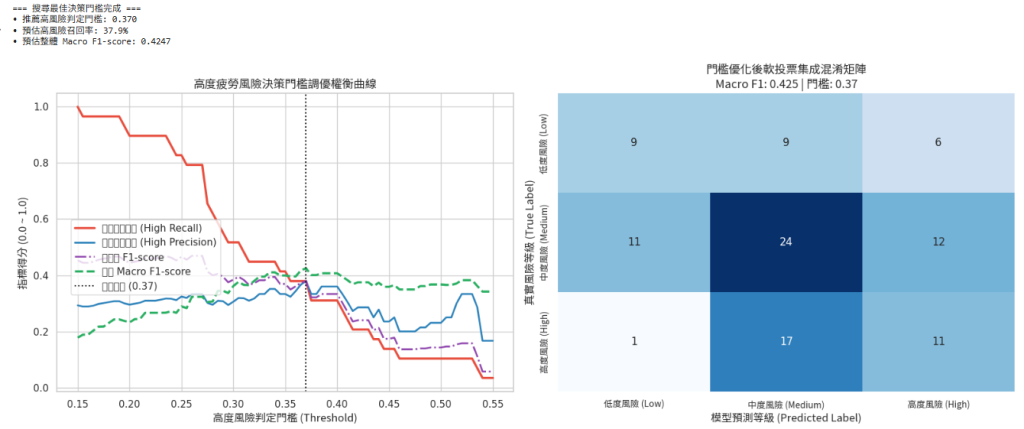
print(f"=== 搜尋最佳決策門檻完成 ===")
print(f"• 推薦高風險判定門檻: {best_th:.3f}")
print(f"• 預估高風險召回率: {best_row['recall_high']*100:.1f}%")
print(f"• 預估整體 Macro F1-score: {best_row['macro_f1']:.4f}\n")

# 5. 繪製 1x2 畫布:門檻權衡曲線 + 優化後混淆矩陣
fig, axes = plt.subplots(1, 2, figsize=(16, 6))
sns.set_theme(style="whitegrid")

# --- 圖 1:動態門檻與高風險評估指標變化曲線 ---
axes[0].plot(eval_df['threshold'], eval_df['recall_high'], label='高風險召回率 (High Recall)', color='#e74c3c', linewidth=2.5)
axes[0].plot(eval_df['threshold'], eval_df['prec_high'], label='高風險精確率 (High Precision)', color='#2980b9', linewidth=2)
axes[0].plot(eval_df['threshold'], eval_df['f1_high'], label='高風險 F1-score', color='#8e44ad', linewidth=2, linestyle='-.')
axes[0].plot(eval_df['threshold'], eval_df['macro_f1'], label='全域 Macro F1-score', color='#27ae60', linewidth=2.5, linestyle='--')

axes[0].axvline(best_th, color='black', linestyle=':', linewidth=1.5, label=f'最佳門檻 ({best_th:.2f})')
axes[0].set_title('高度疲勞風險決策門檻調優權衡曲線', fontproperties=my_font, fontsize=13, fontweight='bold')
axes[0].set_xlabel('高度風險判定門檻 (Threshold)', fontproperties=my_font, fontsize=12)
axes[0].set_ylabel('指標得分 (0.0 ~ 1.0)', fontproperties=my_font, fontsize=12)
axes[0].legend(loc='center left', bbox_to_anchor=(0.02, 0.45))

# --- 圖 2:套用最佳門檻之最終測試集混淆矩陣 ---
y_pred_opt = []
for p in y_prob_ens:
    if p[2] >= best_th:
        y_pred_opt.append(2)
    else:
        y_pred_opt.append(np.argmax(p[:2]))
y_pred_opt = np.array(y_pred_opt)

target_names = ['低度風險 (Low)', '中度風險 (Medium)', '高度風險 (High)']
cm_opt = confusion_matrix(y_test, y_pred_opt)

sns.heatmap(
    cm_opt,
    annot=True,
    fmt='d',
    cmap='Blues',
    xticklabels=target_names,
    yticklabels=target_names,
    cbar=False,
    ax=axes[1]
)
opt_macro_f1 = f1_score(y_test, y_pred_opt, average='macro')
axes[1].set_title(f'門檻優化後軟投票集成混淆矩陣\nMacro F1: {opt_macro_f1:.3f} | 門檻: {best_th:.2f}', fontproperties=my_font, fontsize=13, fontweight='bold')
axes[1].set_xlabel('模型預測等級 (Predicted Label)', fontproperties=my_font, fontsize=12)
axes[1].set_ylabel('真實風險等級 (True Label)', fontproperties=my_font, fontsize=12)
axes[1].set_xticklabels(target_names, fontproperties=my_font, fontsize=10)
axes[1].set_yticklabels(target_names, fontproperties=my_font, fontsize=10)

plt.tight_layout()
plt.show()

# 6. 輸出詳細評估報告
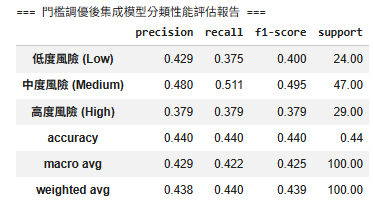
print("=== 門檻調優後集成模型分類性能評估報告 ===")
display(pd.DataFrame(classification_report(y_test, y_pred_opt, target_names=target_names, output_dict=True)).T.round(3))
三、圖表解讀與客觀數據分析
本實作結合了第一名 LightGBM(權重 0.6) 與第二名 隨機森林優化版(權重 0.4) 進行軟投票集成,並對預測難度最高、臨床警示意義最重的「高度疲勞風險」實施動態分類門檻移動。從最佳決策門檻搜尋結果、指標動態權衡曲線、混淆矩陣熱力圖及分類評估報告中,可提煉出三項關鍵的工程實證成果:


 iThome鐵人賽
 看影片追技術