
前面幾天的 SGLang RVV 後端走手寫路線:自己決定 operator boundary,用 C++ / RVV intrinsic 寫 kernel,再透過 torch.ops.sgl_kernel.* 接回 Python。今天開始看讓 torch.compile 從一般 PyTorch 程式擷取計算圖,再由 TorchInductor 產生 CPU kernel。
今天我主要參考 ASPLOS 2024 的 PyTorch 2: Faster Machine Learning Through Dynamic Python Bytecode Transformation and Graph Compilation。今天的文章可以配合論文一起看,然後論文描述 PyTorch 2 初期的設計與 2023 年 nightly build 實驗,後來版本的細部 heuristic 和 API 可能已調整,這裡把它當成理解 compiler architecture 的主要來源。
linear + relu 開始linear + relu 開始import torch
def f(x, w, b):
return torch.nn.functional.linear(x, w, b).relu()
opt_f = torch.compile(f, backend="inductor")
x = torch.randn(64, 2048)
w = torch.randn(3072, 2048)
b = torch.randn(3072)
y = opt_f(x, w, b)
torch.compile 傳回一個包裝後的 callable,第一次執行 opt_f(x, w, b) 時,compiler stack 才根據當下的 Python 路徑與 tensor metadata 開始 graph capture 和 JIT compilation。
在 CPU 情境下,這次呼叫可以分成三段
Capture
  Python bytecode -> FX graph + guards

Compile
  AOTAutograd -> decompositions -> Inductor IR -> scheduling/codegen

Run
  C++ compiler -> .so -> Python wrapper 載入並呼叫 kernel
後續呼叫會先檢查 guards。條件符合時可以重用已編譯的 artifact;條件不符時,Dynamo 會嘗試使用其他 cache entry,或重新 capture 與 compile。
PyTorch eager mode 採用 define-by-run,Python 程式執行到一個 tensor operation,dispatcher 就送出對應的 operator。這個模式保留了 Python 的 control flow、class、list、dictionary、logging 與第三方套件,也能直接用 print 或 pdb 除錯。
compiler 只看到單一 operator 時,很難做跨 operator 的最佳化。例如 linear 後面緊接 relu,eager mode 可能產生中間 tensor,再啟動下一個 kernel。看到整段 graph 的 compiler 才有機會融合 epilogue、減少中間 buffer,或重排 loop 與 memory access。
早期 graph capture 方法常要求使用者改寫程式,或只記錄某次 execution path。論文用 torch.jit.trace、torch.jit.script、Lazy Tensor 與 torch.fx.symbolic_trace 說明這個困難:PyTorch 現實中的模型已經大量使用 Python 語意,graph capture 必須處理這些程式,不能只限定使用者寫成純 graph language。
TorchDynamo 的做法是在 CPython 執行 bytecode 之前分析它,擷取可編譯的 PyTorch operation sequence,然後把 compiled callable 寫回新的 Python bytecode。程式可以同時包含 compiled graph 和原本的 Python execution。
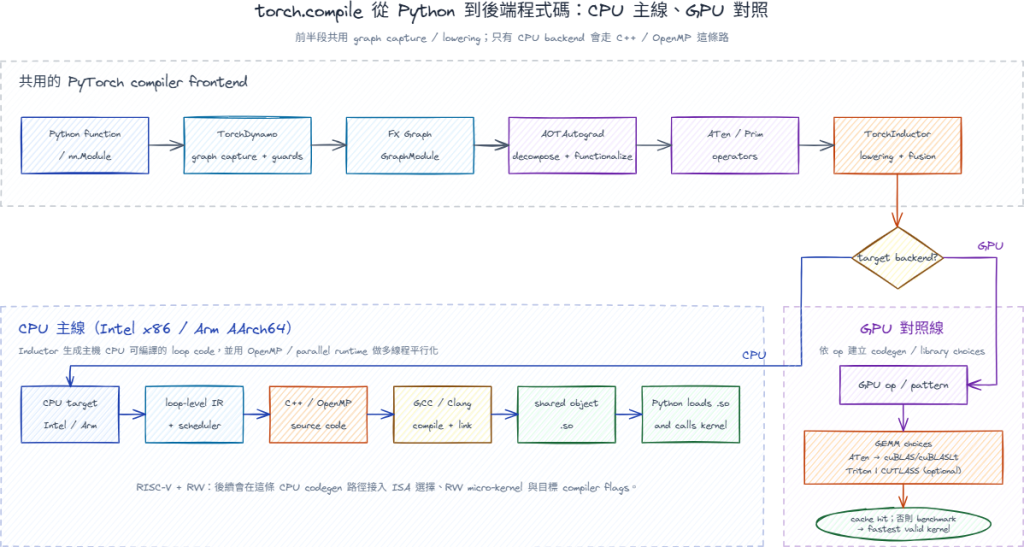
上半圖的 graph capture 與 lowering 是共用路徑。到 backend 才會根據 device、operator、shape、dtype 與 layout 建立可用實作。CPU 路徑主要產生 C++ / OpenMP。GPU 的 pointwise 與 reduction 常由 Triton codegen 處理,GEMM 類 operator 還可以保留 ATen external kernel,並在啟用 max-autotune 後與 Triton 或其他可用 template 比較,選擇最快的有效的實作,之後 wrapper 呼叫選中的 kernel 或 external library。
TorchDynamo 是 Python-level JIT compiler,它透過 PEP 523 提供的 CPython frame evaluation hook,在 function frame 執行前介入。
Dynamo 的 symbolic evaluator 會逐條讀取 Python bytecode,同時維護
遇到 tensor operation 時,Dynamo 在 FX graph 加入 node,遇到 Python constant、list、dictionary、module attribute 或 user-defined function 時,它會用對應的 symbolic representation 追蹤。能夠安全 inline 的 function 會被展開,依賴 tensor shape 或 Python type 的 branch 可能被特化成當前路徑。
完成分析後,Dynamo 會產生新的 Python bytecode,新 bytecode 會呼叫 compiled FX graph,恢復 local / stack state,執行必要的 side effects,最後回到原本 Python control flow。
JIT compiler 會根據擷取當下看到的資訊做 specialization
x.dtype == torch.float32
x.device == cpu
x.size() == (64, 2048)
x.stride() == (2048, 1)
module.training == False
Guards 將這些假設轉成 runtime checks。每個 compiled cache entry 都會搭配 guard function;下次呼叫時,guard 通過才能使用對應的轉換後 bytecode 與 compiled artifact。
Guards 不只來自 TorchDynamo。AOTAutograd 與 TorchInductor 也可以為自己的 specialization 加入條件。所以重新編譯的原因可能來自 shape、stride、dtype、Python value、module state,或 backend 做的 codegen 選擇。
Dynamo 遇到無法安全處理的 operation 時,會在當下位置產生 graph break。常見來源包含第三方 Python library、tensor 轉成 Python value,以及依賴 tensor data 的 control flow。
發生 graph break 時,Dynamo 會先編譯已經擷取的 partial FX graph,將無法擷取的 bytecode 交回 CPython,然後透過 continuation function 從中斷點後面繼續分析。論文用 resume_at_X 表示這類 continuation,它會接收跨過 graph break 仍然活著的 variables,恢復 stack / exception state,再跳回原本程式位置。
compiled graph 0
-> CPython 執行不支援的運算
-> resume_at_X(...live variables...)
-> compiled graph 1
這個機制讓 partial graph 仍然可用,Graph break 太多時,kernel fusion 的範圍會變小,Python 與 dispatcher overhead 也會回來,因此它同時是功能性邊界與效能診斷訊號。
TorchDynamo 擷取的 tensor operation 會用 FX GraphModule 表示,對前面的例子,graph 大致可能包含
placeholder x
placeholder w
placeholder b
call_function aten.linear
call_function aten.relu
output
FX Graph 是 Dynamo 與 backend compiler 之間的一個介面,還沒有完成硬體特定scheduling。後續 pass 會繼續做 decomposition、functionalization、shape propagation、lowering 與 fusion
backend= 參數也表示 Dynamo 和 Inductor 是可分開的組件,Dynamo 負責 capture 和重寫 Python,預設 backend 是 Inductor,使用者也可以提供其他 backend 來接收 FX graph。
TorchDynamo 先擷取 model forward,訓練時還需要 backward graph,AOTAutograd 會用 fake tensor inputs 執行 eager autograd engine,記錄 joint forward / backward graph,再用 min-cut algorithm 切成獨立的 forward 和 backward graph。這個切分還會考慮 activation 要保留還是在 backward 重新計算,藉此調整記憶體使用。
這裡的 fake tensor 只保留 shape、dtype、device、stride 等 metadata,不需要配置實際tensor data。compiler 可以用這些 metadata 做 shape propagation 和 operator analysis。依賴實際資料的 operation 無法只靠 fake tensor 決定結果,可能使 Dynamo 切開 graph。
AOTAutograd 還會做兩類對 backend 很重要的轉換
這個系列接下來主要看 inference,但 AOTAutograd 仍然會參與 decomposition 和 functionalization。
TorchInductor 是 torch.compile 的預設 backend。論文強調它的幾個設計選擇,用與 PyTorch eager 接近的 tensor / storage abstraction 處理 stride、view、alias 和 mutation,compiler 主體用 Python 實作,TorchInductor 也是很多後端,根據後端產生程式碼,像是 GPU Triton 和 CPU C++ / OpenMP。
Inductor 不需要為每個 PyTorch operator 寫一份專用 codegen,一部分 operator 會先通過 decomposition 展開,再將簡化後的 FX node lowering 到 Inductor IR。如果遇到沒有 lowering 的 operator,Inductor 可以產生 fallback kernel node,呼叫原本 PyTorch implementation。
論文將 Inductor IR 稱為 define-by-run loop-level IR。Loop body 由可執行的 Python function 定義,並透過一組小型 primitive operations 表示
ops.load
ops.store
ops.reduction
ops.index_expr
ops.indirect_indexing
ops.masked
Tensor shape 和 stride 可以用 SymPy symbol 表示,loop body 只需描述某一個 index 上應該執行的運算。同一份 IR 可以切換 analysis handler 來收集 memory access,也可以切換 codegen handler 產生 Triton 或 C++。
Scheduler 會把 IR buffer 轉成 scheduler nodes,建立 memory read / write dependency,然後決定
Fusion 先要通過 dependency 與 indexing 檢查。寫入與讀取順序不相容時,把兩個 loop 合在一起可能改變結果。通過合法性檢查後,Inductor 再根據 fusion category、預估可節省的 memory traffic,以及 nodes 在原 graph 的距離排序候選項目。
這段解釋了 compiler 為什麼需要 graph。將 pointwise、reduction 與 scatter 合併成較少 kernels,可以讓中間值留在 register 或 cache 附近,減少寫回主記憶體後再讀取的次數。
CPU backend 會產生 C++ / OpenMP,分成 vectorized 與 non-vectorized 兩類路徑。
Vectorized 路徑會做 tiling,並把多數 operation 對應到 PyTorch at::vec::Vectorized abstraction。這個 abstraction 能在不同 CPU SIMD ISA 上提供共用介面。Non-vectorized 路徑則產生比較標準的 C++ / STL code。兩條路徑都可以用 #pragma omp for 平行化 loop,reduction 則根據 loop 是否平行來選擇 OpenMP reduction 或 C++ accumulator。
一個大幅簡化後的 pointwise kernel 可能長這樣:
extern "C" void kernel(const float* x, float* y, int64_t n) {
    #pragma omp parallel for
    for (int64_t i = 0; i < n; ++i) {
        y[i] = x[i] > 0.0f ? x[i] : 0.0f;
    }
}
實際 generated code 還要處理 tensor pointer、size、stride、dtype、temporary buffer、parallel scheduling 與 external kernel call。Wrapper codegen 會負責 tensor size calculation、memory allocation / deallocation,並呼叫 C++、Triton 或 external source 的 kernels。所以一個 compiled graph 可以同時包含 generated kernel 和 library call。
CPU C++ source 會交給 C++ compiler,再編譯成 Linux shared object(.so)。GCC 或 Clang 的選擇受 PyTorch / Inductor 設定、環境變數與目標平台影響,常見來源包含
CXX / CC
torch._inductor.config.cpp.cxx
torch._inductor.config.cpp.march
g++ 或 clang++
對 x86 或 Arm CPU,target flags 會決定 compiler 可以使用的 SIMD ISA。RISC-V 情境下,rv64gc 不包含 V extension,開啟 RVV 需要對應的 -march 與 CPU capability。Generated C++ 使用 RVV intrinsic 時,還要確認 target compiler 版本能正確編譯。
我目前的 Banana Pi 實驗將 Inductor JIT compiler 固定為 GCC/G++ 15。這是本實驗環境的工具鏈選擇,主要用來避開早期 compiler 的 RVV intrinsic 相容性問題,不代表所有 RISC-V CPU 必須使用同一個 compiler 版本。
LLM 推論會讓 batch size、sequence length 與 KV cache 狀態持續變化。如果 compiler 只支援 static shape,每種 shape combination 都可能需要新 kernel,編譯成本與 cache artifacts 會迅速增加。
論文的 dynamic shape 設計使用 symbolic integers 表示 size 和 stride。每個 symbolic size 同時保留第一次 capture 看到的 concrete hint。遇到 shape-dependent branch 時,Dynamo 用 hint 選擇當前路徑,再產生 guard 保護這個 specialization,中間 tensor 的 shape 則透過 meta function 傳播,不需要執行真實運算。
例如
def f(x, y):
    z = torch.cat([x, y])
    if z.size(0) > 2:
        return z * 2
    return z + 2
compiler 會根據當次 input 選擇其中一條 branch,並把 z.size(0) 改寫成與 input shapes 有關的 symbolic expression。當後續 input 無法滿足 guard,就需要使用其他 cache entry 或重新編譯。
這是 serving 環境要檢查 recompilation 的原因。dynamic=True 不等於一份 kernel 自動涵蓋所有控制路徑;symbolic shape 可以擴大 artifact 可重用的範圍,仍然受 guards、data-dependent control flow 與 backend codegen capability 限制。而且 dynamic shape 推理本身也有成本,精確 heuristic 會隨 PyTorch 版本調整。
torch.compile 可以減少 Python 與 dispatcher overhead,但論文的消融實驗指向更大的來源,Inductor 的 inlining 與 fusion 將 pointwise、reduction 與 scatter 組合成更少 kernels,藉此減少 memory traffic。論文關閉 fusion 與 inlining 後,整體結果會落到 eager 以下。所以只看 Python 呼叫次數,無法解釋 compiler 的全部收益。
論文實驗在 NVIDIA A100 上 180 多個模型的實驗,有 2.27× inference 與 1.41× training geometric mean 加速
CPU 的第一次執行可能包含
Dynamo bytecode analysis
-> guards / graph breaks
-> AOTAutograd + decompositions
-> Inductor lowering + scheduling
-> C++ source generation
-> GCC / Clang compile + link
-> .so load
-> first kernel execution
後續執行在 guards 通過時才能重用 compiled artifact。因此 benchmark 至少要分開
LLM serving 還要記錄重新編譯次數、cache 命中率、每種 batch / sequence shape 的 artifact 數量,以及 weight prepack 所增加的時間與記憶體。
讀完流程後,可以先看 graph break、guards 與 recompilation
TORCH_LOGS="graph_breaks" python example.py
TORCH_LOGS="guards" python example.py
TORCH_LOGS="recompiles" python example.py
graph_breaks 幫助找到 Python 和 compiled graph 的分界;guards 列出 artifact 的使用條件,recompiles 會顯示哪個 guard failure 觸發重新編譯。這三組訊息能把第一次很慢或shape 變化後又 compile轉成可查驗的原因。
torch.compile 和 SGLang RVV 的關係前面幾篇的 SGLang RVV backend 是手寫 operator 路線
SGLang Python
-> torch.ops.sgl_kernel.*
-> 手寫 C++ / RVV intrinsic kernel
PyTorch Inductor RVV 是 compiler 路線
SGLang / PyTorch model code
-> torch.compile
-> FX / ATen graph
-> TorchInductor CPU backend
-> generated C++
-> RVV micro-kernel
手寫路線要自己維護 operator boundary、tensor layout、custom op schema、dispatch 與 kernel。
Compiler 路線則要處理 graph capture、guards、fallback、ISA selection、template routing、weight prepack 與 artifact cache。
對目前的 PyTorch Inductor RVV 實驗,需要追蹤的位置
Inductor CPU target selection
-> RVV capability / compiler flags
-> C++ template routing
-> BF16 GEMV / GEMM micro-kernel
-> generated C++ artifact
-> SGLang workload
明天會進入 PyTorch Inductor RVV,具體看 VecRVV 如何被選到、RVV BF16 micro-GEMM 如何產生,以及 blocked weight layout 為什麼會影響 SGLang 的 prefill 與 decode。



 iThome鐵人賽
 看影片追技術