

昨天的 TT-Metal 範例要手動安排 reader、compute、writer、circular buffer 與 NoC synchronization。今天看 TT-MLIR 怎麼用多個 MLIR dialect 串接 tensor graph、TTNN operation、TT-Metal host program 與 device kernel。
今天用 TT-MLIR 官方 Overview 的架構圖與 IR 範例。我們會先用同一個 simple_linear 比較 TTIR 與 TTNN,再用官方 simple_matmul 追蹤 D2M、TTKernel 與 TTMetal 新增了哪些執行資訊,文中架構以目前commit 為主。
ttmlir-opt 如何選擇 TTNN 或 TTMetal pipeline。TT-MLIR 定義 Tenstorrent 相關的 dialect、transformation pass、binary interface 與 runtime component,也可以作為其他 compiler 專案取用的元件庫。
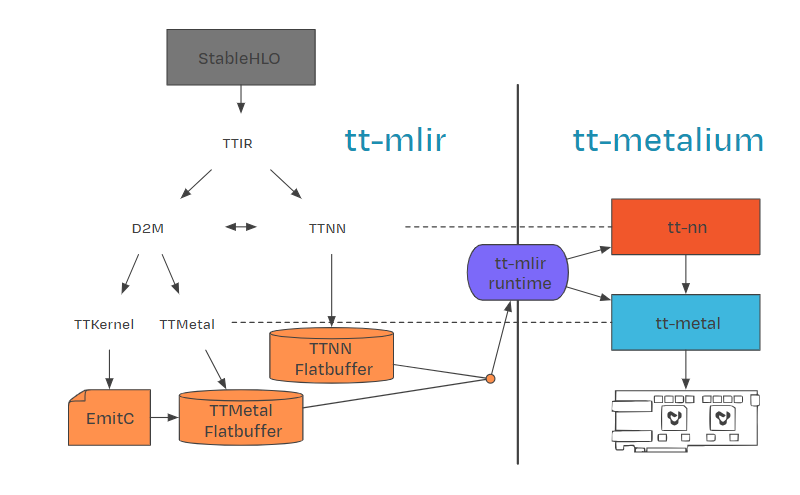
這張圖可以看到分成兩個主要方向
TTIR → TTNN → TTNN FlatBuffer → TTNN runtime:保留高階 TTNN API operation,交給 tt-nn 執行。TTIR → D2M → TTKernel + TTMetal:把 generic compute、data movement、device kernel 與 host program 展開。TTNN 和 D2M 之間的雙向箭頭,表示它們是可供 compiler 組合的不同抽象
昨天畫過的 software stack 可以再細化成
PyTorch / JAX / ONNX 等 model source
  ↓
StableHLO 或其他 front-end dialect
  ↓
TT-MLIR
  TTIR
  ├─→ TTNN dialect → TTNN FlatBuffer → TTNN runtime
  └─→ D2M → TTKernel + TTMetal → TTMetal FlatBuffer
  ↓
tt-metal / Tenstorrent hardware
根據這個版本的官方 FlatBuffers 文件,.ttb 所對應的 TTMetal backend runtime 仍標示為 unsupported,架構圖表達的是 compiler 元件與介面,不代表圖中每條 runtime 路徑都有相同的完整度。
| Dialect | 保留的資訊 | 代表性 operation / type |
|---|---|---|
ttir |
高階 tensor compute graph,重點是要算什麼 | ttir.linear、ttir.to_layout、ttir.generic |
ttnn |
貼近 TTNN API 的 tensor operation,帶有 TTNN layout 與 tensor lifetime | ttnn.linear、ttnn.deallocate |
d2m |
將 generic compute 對應到 tile、grid、iterator 與顯式 data movement | d2m.generic、d2m.to_layout、d2m.wait |
ttkernel |
在 device 上執行的低階 kernel | ttkernel.noc_async_read、ttkernel.cb_push_back、ttkernel.experimental.matmul_block |
ttmetal |
Host 端的 buffer、transfer 與 program dispatch | ttmetal.create_buffer、ttmetal.enqueue_program |
這五個 dialect 可以對回前兩天的硬體與 TT-Metal 概念
tensor 要做什麼
  → ttir / ttnn

tile 長什麼樣、放 DRAM 還是 L1、映射到哪個 grid
  → d2m

reader / compute / writer 的 circular buffer、NoC 與 tile operation
  → ttkernel

host 如何配置 buffer 並啟動 program
  → ttmetal
MLIR dialect 讓這些決策在不同階段仍有明確名稱。Compiler pass 可以先處理 tensor graph,後面才將 layout、memory space、grid、kernel synchronization 與 host dispatch 逐步寫進 IR。
| 階段 | 保留內容 | 新增內容 | 後續處理 |
|---|---|---|---|
| TTIR | linear、matmul 這類 tensor operation,logical shape 與 dtype |
Tenstorrent tensor graph 語意 | DRAM / L1、tile、core grid、CB、NoC、host dispatch |
| TTNN | ttnn.linear 等 TTNN API operation |
TTNN layout、physical tile、memory space、interleaved / sharded、tensor lifetime | 實際 reader / compute / writer kernel 與 NoC 步驟 |
| D2M | generic loop 中的 tile compute | physical tiled tensor、L1 layout、grid、indexing map、parallel / reduction iterator、CB wait / reserve |
每個 kernel 的低階 API 呼叫與 host enqueue |
| TTKernel | reader / compute / writer 的 device code | CB port、NoC / compute thread、tile register、顯式同步與 tile instruction | Host buffer 如何配置與 program 何時啟動 |
| TTMetal | Host 程式與 kernel 之間的連結 | buffer address、core range、kernel config、CB port、semaphore、write / launch / read / finish | 高階 linear 或 matmul 名稱已經淡出主要表示 |
可以把 lowering 看成用更多執行細節,換掉一部分高階名稱。例如 ttir.linear 在 TTNN 路徑還會保留為 ttnn.linear,走 D2M / TTKernel 路徑時,後面讀到的是 reduction iterator、tile matmul、CB 同步與 program dispatch。它們共同實現 matmul,但 IR 不再依賴單一個高階 matmul operation 來表達整個執行過程。
ttir.linear 讀高階 tensor 語意官方 Overview 用 simple_linear 當例子。TT-MLIR TTIR 階段可以簡化成
func.func @simple_linear(
  %arg0: tensor<64x128xbf16>,
  %arg1: tensor<128x64xbf16>,
  %bias: tensor<64x64xbf16>) -> tensor<64x64xbf16> {
  %0 = ttir.empty() : tensor<64x64xbf16>
  %1 = "ttir.linear"(%arg0, %arg1, %bias, %0)
      : (...) -> tensor<64x64xbf16>
  return %1 : tensor<64x64xbf16>
}
這個階段已經知道 input、weight、bias 與 output shape,也保留 linear 的高階語意。它還沒指定實際的 DRAM / L1 layout、core grid、circular buffer 與 NoC transfer。
這樣的 IR 適合做 graph-level transformation。例如 compiler 可以在 linear 還是 named op 時做 decomposition、fusion 或 layout-related rewrite,不用從一大段低階 loop 與記憶體操作重新推回它的 tensor 語意。
同一個 simple_linear lower 到 TTNN dialect 後,operation 變成 ttnn.linear,tensor type 開始帶 TTNN layout
#layout = #ttnn.ttnn_layout<
  (d0, d1) -> (d0, d1),
  <1x1>,
  memref<2x4x!ttcore.tile<32x32, bf16>, #dram>,
  <interleaved>>

%0 = "ttnn.linear"(%arg0, %arg1, %arg2) <{
  transpose_a = false,
  transpose_b = false
}> : (...) -> tensor<64x64xbf16, #layout>
這裡可以看到幾個新資訊
64x64 BF1632x32 tilelinear 已經對到 TTNN API 的 operation 與 attributeTTNN IR 裡還會出現 ttnn.deallocate,表示 compiler / runtime 介面已經需要處理 tensor lifetime。TTIR 的高階計算圖不需要暴露這些 runtime 細節,降階到 TTNN 後就必須把它們具體化
把官方兩段 simple_linear 並排後,差異可以濃縮成三點
linear 語意都還在。#ttnn.ttnn_layout,ttnn.linear 加入 transpose_a / transpose_b,並且出現 ttnn.deallocate。ttir.empty 建立 output tensor;官方 TTNN 範例由 ttnn.linear 直接產生結果,所以原本的 output empty 不再出現。這也說明 lowering 不只是把 operation prefix 從 ttir 換成 ttnn。Tensor type、operation attribute、結果產生方式與資源生命週期都改了。
simple_matmul 範例官方 Overview 的 TTIR 與 TTNN 分頁使用 simple_linear,D2M、TTKernel 與 TTMetal 分頁則改用 simple_matmul。下面採用第二個範例觀察抽象的變化,官網沒有提供同一份 simple_linear 逐行 lowering 到 TTMetal 的紀錄。
simple_matmul 的 logical tensor shape 是
A: 64x128
B: 128x96
C: 64x96
D2M 先用 d2m.to_layout 將三個 logical tensor 轉成 L1 內的 physical tiled tensor
64x128  → 1x1x2x4 tiles
128x96  → 1x1x4x3 tiles
64x96   → 1x1x2x3 tiles

每個 tile = 32x32 bf16
這些數字可以直接對回 shape,64 / 32 = 2、128 / 32 = 4、96 / 32 = 3。接著,d2m.generic 寫進執行網格、indexing map 與 iterator type。下面保留官方範例的關鍵 operation,省略完整 type signature
// 根據官方範例縮寫,不能直接執行
%7 = d2m.generic {
  grid = #ttcore.grid<1x1>,
  indexing_maps = [#map_a, #map_b, #map_c],
  iterator_types = [parallel, parallel, reduction],
  threads = [#d2m.thread]
} ... {
  %a = d2m.wait %cb0
  %b = d2m.wait %cb1
  %c = d2m.reserve %cb2
  %result = d2m.tile_matmul %a, %b, %c
  ...
}
兩個 parallel iterator 對應輸出的 tile,reduction iterator 對應 matmul 的 K 軸。wait 表示等輸入 CB 可讀,reserve 表示預留輸出 CB 空間。到了這一層,輸入是否就緒、輸出是否有位置可寫,已經成為 IR 的一部分。
官方 TTKernel 範例將 kernel 標記為 NoC thread 或 compute thread,並把 CB 編號作為 compile-time argument。下面是官方 compute kernel 的關鍵 operation,參數已經縮寫:
// 參數已縮寫,不能直接執行
ttkernel.cb_wait_front(%cb0, %one)
ttkernel.cb_wait_front(%cb1, %one)
ttkernel.cb_reserve_back(%cb2, %one)

ttkernel.tile_regs_acquire()
ttkernel.mm_block_init_short(...)
ttkernel.experimental.matmul_block(...)
ttkernel.pack_tile(...)

ttkernel.cb_pop_front(%cb0, %one)
ttkernel.cb_pop_front(%cb1, %one)
ttkernel.cb_push_back(%cb2, %one)
D2M 的 wait / reserve 現在展開成 CB front / back 同步,compute 也顯式使用 tile register、matmul instruction 與 pack。這些 operation 的形狀已經很接近昨天手寫的 TT-Metal compute kernel。
TTMetal dialect 處理 host 端編排,官方範例不只出現 enqueue_program,它的 attribute 還會指定處理器核範圍、NoC0 / NoC1 data-movement kernel、compute kernel 與 CB port。下面的縮寫版省略了完整 memref type 與 kernel argument
// 根據官方範例縮寫,不能直接執行
%buffer = ttmetal.create_buffer ...
ttmetal.enqueue_write_buffer ...

ttmetal.enqueue_program ... <{
  cb_ports = [0, 1, 2],
  kernelConfigs = [
    noc_config<@reader,  core_range<0x0, 2x3>, noc0>,
    noc_config<@writer,  core_range<0x0, 2x3>, noc1>,
    compute_config<@compute, core_range<0x0, 2x3>>
  ]
}>

ttmetal.enqueue_read_buffer ...
ttmetal.finish
此時的 IR 可以回答哪些 device kernel 在哪個處理器核網格上執行,也能表示 buffer address、semaphore 與 kernel argument。高階 matmul 語意已經分散到 buffer、reader、compute、writer 與 host command 之中。
這就是 TT-MLIR 和 TT-Metal 之間的具體連結,昨天從 API 和 kernel 分工往上看,今天從 tensor graph 往下追,兩邊會在 circular buffer、NoC operation、tile compute 與 host dispatch 匯合。
ttmlir-opt 觀察 pipelineTT-MLIR 提供 ttmlir-opt 當 optimizer driver,用來對 .mlir 檔執行 compiler pass。官方文件給了兩條可直接對照的指令
./build/bin/ttmlir-opt \
  --ttir-to-ttnn-runtime-pipeline \
  test/ttmlir/Dialect/TTNN/simple_multiply.mlir

./build/bin/ttmlir-opt \
  --ttir-to-ttmetal-pipeline \
  test/ttmlir/Dialect/TTNN/simple_multiply.mlir
兩道指令的 input 可以相同,pipeline option 決定後面保留哪組 dialect 與要對接的 runtime 形狀。這也是 MLIR multi-level design 的一個具體例子,前面可以共用 TTIR 的 tensor semantics,後面依 backend 需求分流。
TT-MLIR 的 Target 目錄定義 FlatBuffer schema,專案文件將它描述為 compiler 和 runtime 之間的 binary interface,目前列出三種副檔名
| 副檔名 | 用途 | 這個版本的狀態 |
|---|---|---|
.ttsys |
記錄 target system description,可用於 cross-compilation | 用來把裝置資訊交給 compiler |
.ttnn |
TTNN backend runtime 載入與執行的 compiled binary | TTNN runtime 路徑 |
.ttb |
TTMetal backend runtime 的 compiled binary | 官方文件標示 unsupported |
.ttsys 很適合用來理解 cross-compilation。Compiler 可以從 target machine 收集 system description,再將它帶回 development machine。這讓 target topology 和 compiler IR 保持分開,也讓上層 pipeline 不必直接查詢正在執行的裝置。
從官方 IR 與 pipeline 文件,可以確認 TT-MLIR 如何分開 high-level tensor IR、TTNN op、generic data movement、device kernel 與 host dispatch。這些材料還不足以回答
這些問題需要版本、build configuration、裝置、compiler output 和實測記錄
今天用官方架構圖、simple_linear、simple_matmul、ttmlir-opt 和 FlatBuffer 把 TT-MLIR 的 compiler flow 走過一次
TTIR 之後主要分成 TTNN 與 D2M 兩個方向,整體流程不能畫成單一直線ttir 保留高階 tensor compute graphttnn 對應 TTNN API,並加入 physical tile、memory space、layout 與 tensor lifetimettcore 提供 tile、grid、layout 與 memory space 等共用定義d2m 將 matmul 展開成 tiled generic compute、iterator、grid 與 CB data movementttkernel 把 CB 同步與 tile instruction 寫進 device kernel,ttmetal 負責 host buffer、kernel config 與 program dispatch.ttnn 和 .ttb 代表不同 backend 的 binary interface,這個版本的 .ttb 仍標示 unsupported明天回到 Triton,之前介紹主要是 Trtion GPU 的 compile 流程,但最近對於 Triton 在不同 NPU 上面是如何 compile 很有興趣,會整理目前有哪些專案在實作,看它們從 Triton 的哪一層 IR 分流,以及如何接進各自的 backend dialect 與 runtime。


 iThome鐵人賽
 看影片追技術