
key 不要用陣列索引」這句話大家都聽過,但用了會怎樣?是變慢,還是出錯?key 跟寫 key={index},哪個比較糟?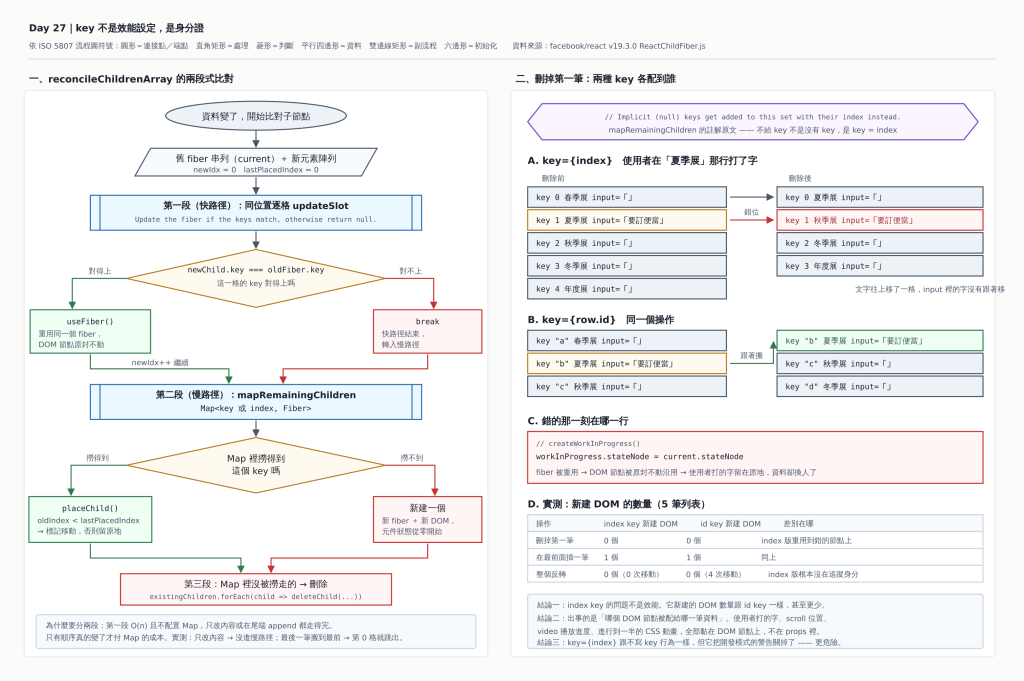
Day 26 講的是「同一筆資料回來,怎麼讓 React 別動」——replaceEqualDeep 內容沒變就回傳原本那個物件,讓 Object.is 判定相等,React 就有機會跳過。
今天反過來:資料真的變了,React 要動哪幾個節點。
兩篇合起來才是完整的一句話:
React 沒有響應式的攔截層(Day 23),所以它只能靠比參考判斷「還是同一個東西嗎」。物件層面的比較交給
Object.is(Day 26),而列表層面的比較交給key(今天)。
key 就是你親手交給 React 的那個「身分證」。今天要講的是:它拿去做什麼、以及你給錯的時候它會怎麼處理。
用的版本是 React v19.3.0,檔案是 packages/react-reconciler/src/ReactChildFiber.js。跟 Day 24 一樣,下面引用的原始碼都是我實際讀那個 tag 抄下來的。
reconcileChildrenArray 的骨架是兩個 for 迴圈。先講結構,再看程式碼。
key。一格對不上就 break
Map,用 key 去撈Map 裡沒被撈走的,就是真的被刪掉了第一段的迴圈長這樣(節錄):
for (; oldFiber !== null && newIdx < newChildren.length; newIdx++) {
  if (oldFiber.index > newIdx) {
    nextOldFiber = oldFiber;
    oldFiber = null;
  } else {
    nextOldFiber = oldFiber.sibling;
  }
  const newFiber = updateSlot(returnFiber, oldFiber, newChildren[newIdx], lanes);
  if (newFiber === null) {
    // ...
    break;
  }
  // ...
  lastPlacedIndex = placeChild(newFiber, lastPlacedIndex, newIdx);
  // ...
}
白話解釋這段:它一格一格往下走,每格問一次 updateSlot。只要有一格回傳 null,整個迴圈就 break。
而 updateSlot 的第一行註解把它的職責講完了:
function updateSlot(returnFiber, oldFiber, newChild, lanes) {
  // Update the fiber if the keys match, otherwise return null.
  const key = oldFiber !== null ? oldFiber.key : null;
  // ...
      case REACT_ELEMENT_TYPE: {
        if (newChild.key === key) {
          // ...
          return updateElement(returnFiber, oldFiber, newChild, lanes);
        } else {
          return null;
        }
      }
key 對上就重用,對不上就回 null。 沒有模糊空間,也沒有「相似度」這種東西——它是嚴格的相等比較。
實測輸出(我照原始碼手寫了一個最小版,完整程式碼在文末):
劇本一:只改內容,順序沒變
    第 0 格:key="a" 對上,重用同一個 DOM 節點
    第 1 格:key="b" 對上,重用同一個 DOM 節點
    第 2 格:key="c" 對上,重用同一個 DOM 節點
    第 3 格:key="d" 對上,重用同一個 DOM 節點
    第 4 格:key="e" 對上,重用同一個 DOM 節點
    統計:{"原地更新":5,"移動":0,"插入":0,"刪除":0,"走到慢路徑":false}
劇本二:把最後一筆搬到最前面
    第 0 格:舊 key="a" 新 key="e" → 對不上,跳出快路徑
    進入慢路徑,把剩下 5 個舊項目做成 Map
    Map 的 key 是:["a","b","c","d","e"]
    第 0 格:用 key="e" 從 Map 撈到,重用 dom#10
    第 1 格:用 key="a" 從 Map 撈到,重用 dom#6
    ...
    統計:{"原地更新":5,"移動":4,"插入":0,"刪除":0,"走到慢路徑":true}
分兩段的理由很實際:第一段是 O(n) 而且不配置任何 Map。 而絕大多數的更新——只改內容、在尾端 append——都能走完第一段。只有順序真的變了,才付建 Map 的成本。
注意劇本二:第 0 格就對不上,於是整個列表都走慢路徑。 但因為 key 是對的,五個 DOM 節點一個都沒重建,只是被標記成移動。
key 不是「沒有 key」,是 key = index這是第三個問題的答案,而且不是我推論的,是 mapRemainingChildren 的註解原文:
function mapRemainingChildren(currentFirstChild) {
  // Add the remaining children to a temporary map so that we can find them by
  // keys quickly. Implicit (null) keys get added to this set with their index
  // instead.
  const existingChildren = new Map();

  let existingChild = currentFirstChild;
  while (existingChild !== null) {
    if (existingChild.key === null) {
      existingChildren.set(existingChild.index, existingChild);
    } else {
      existingChildren.set(existingChild.key, existingChild);
    }
    existingChild = existingChild.sibling;
  }
  return existingChildren;
}
白話解釋那三行 if:沒給 key 的項目,React 拿它的位置(index)當 key 存進 Map。
所以:
key={index}與完全不寫key,在比對階段的行為是一樣的。
差別只有一個——不寫 key 在開發模式會被警告,key={index} 不會。
也就是說:
key={index}比不寫key更危險,因為它把警告關掉了,但沒有解決警告在提醒的那件事。
這就是第三個問題的答案。很多人以為 key={index} 是「至少有給 key 了,比不給好」,實際上它只是讓 ESLint 跟 React 閉嘴。
實測兩種 key 的 Map 長相:
    index key 版本的 Map key:[0,1,2,3,4]
    id key 版本的 Map key:   ["a","b","c","d","e"]
刪掉第一筆之後,新列表的第 0 格要去 Map 裡找對應的項目:
0 的那個」,撈到的是原本的第一筆(已經被刪掉那筆的位置)"b",撈到的就是夏季展本人index 當 key 到底會怎樣:先看數字第二個問題。我先給一張表,因為它跟大多數人的直覺不一樣。
五筆資料的列表,五種操作 × 兩種 key,實測 DOM 操作數:
| 操作 | key | 原地更新 | 移動 | 插入 | 刪除 | 新建 DOM | 走慢路徑 |
|---|---|---|---|---|---|---|---|
| 只改一筆的內容 | id | 5 | 0 | 0 | 0 | 0 | 否 |
| 只改一筆的內容 | index | 5 | 0 | 0 | 0 | 0 | 否 |
| 在尾端加一筆 | id | 5 | 0 | 1 | 0 | 1 | 否 |
| 在尾端加一筆 | index | 5 | 0 | 1 | 0 | 1 | 否 |
| 刪掉第一筆 | id | 4 | 0 | 0 | 1 | 0 | 是 |
| 刪掉第一筆 | index | 4 | 0 | 0 | 1 | 0 | 否 |
| 在最前面插一筆 | id | 5 | 0 | 1 | 0 | 1 | 是 |
| 在最前面插一筆 | index | 5 | 0 | 1 | 0 | 1 | 否 |
| 整個反轉 | id | 5 | 4 | 0 | 0 | 0 | 是 |
| 整個反轉 | index | 5 | 0 | 0 | 0 | 0 | 否 |
這張表有三件事跟直覺不一樣:
a. 「刪掉第一筆」在兩種 key 下,新建的 DOM 都是 0。
index key 並沒有「把五個節點全部重建」。它重用了全部節點——問題不是效能,是它重用到錯的節點上。
b. 「在尾端加一筆」用 index key 反而看起來更漂亮(沒進慢路徑)。
這就是為什麼 index key 在很多專案裡看起來完全沒事:只要你只做 append,它真的沒事。 出事的是刪除、插入、排序。所以這個 bug 通常是在產品上線、使用者開始刪東西之後才出現的。
c. 「整個反轉」用 index key 是 0 次移動,用 id key 是 4 次移動。
看起來 index key 贏了。但這是因為 index key 根本沒有在追蹤身分——它沒有「把節點搬過去」,它只是把每個位置上的文字換掉。對純文字列表這樣沒差,對任何帶狀態的東西就是災難。
所以第二個問題的答案是:key={index} 不會讓你變慢,它會讓你出錯。 而且是那種「效能面板上看不出來、只有使用者會抱怨」的錯。
input 內容錯位劇本:五筆展覽,每筆旁邊有一個 <input> 讓你填備註(沒有受 React 控制,也就是所謂的 uncontrolled input)。使用者在「夏季展」那一行打了「要訂便當」,然後按下「刪除春季展」。
用 index 當 key:
  刪除之前:
    dom#75  春季展    input=「」
    dom#76  夏季展    input=「要訂便當」
    dom#77  秋季展    input=「」
    dom#78  冬季展    input=「」
    dom#79  年度展    input=「」
  刪除春季展之後:
    dom#75  夏季展    input=「」
    dom#76  秋季展    input=「要訂便當」   ← 錯位了
    dom#77  冬季展    input=「」
    dom#78  年度展    input=「」
用 row.id 當 key:
  刪除春季展之後:
    dom#81  夏季展    input=「要訂便當」
    dom#82  秋季展    input=「」
    dom#83  冬季展    input=「」
    dom#84  年度展    input=「」
注意 index 版本的 dom# 編號:它們一個都沒變,全部被重用了。只是文字內容往上移了一格,而使用者打的字沒有跟著移。
這一段是今天最值得記的機制:
0」,撈到的是原本第 0 列的 fiberuseFiber() 重用,而 createWorkInProgress 裡有這一行:workInProgress.stateNode = current.stateNode;
DOM 節點被原封不動地沿用了。
props 換成了「夏季展」,但那個 DOM 節點上使用者打的字還在原地input 裡的字留在原處關鍵在於:React 只負責它知道的東西(props、state)。 而下面這些都不在 React 的帳本上,它們黏在 DOM 節點上:
<input>、<textarea>、<select> 裡打的字scroll 位置(包含 <div> 內部的捲動)<video>/<audio> 播到第幾秒、有沒有在播:focus)在哪個元素上還有一類更容易忽略的:子元件自己的 useState。 fiber 被重用,hooks 的 memoizedState 就跟著留下來——所以「展開/收合」的狀態、「編輯中/檢視中」的狀態,都會留在錯的那一行。
所以那句常見的講法——「key 是為了效能」——是錯的,或者至少講反了重點:
key是你告訴 React「這一筆資料的身分」。給錯身分證,使用者的東西就會住到別人家。
placeChild:移動與留在原地的唯一判準第一段跟第二段迴圈裡都會呼叫 placeChild,它是「這一項要不要標記成移動」的唯一決定點。全文很短:
function placeChild(newFiber, lastPlacedIndex, newIndex) {
  newFiber.index = newIndex;
  if (!shouldTrackSideEffects) {
    newFiber.flags |= Forked;
    return lastPlacedIndex;
  }
  const current = newFiber.alternate;
  if (current !== null) {
    const oldIndex = current.index;
    if (oldIndex < lastPlacedIndex) {
      // This is a move.
      newFiber.flags |= Placement;
      return lastPlacedIndex;
    } else {
      // This item can stay in place.
      return oldIndex;
    }
  } else {
    // This is an insertion.
    newFiber.flags |= Placement | PlacementDEV;
    return lastPlacedIndex;
  }
}
白話解釋這段:lastPlacedIndex 記著「目前已經安置好的項目之中,最大的舊索引」。如果某一項的舊索引比它小,代表這一項必須往前跨過已經放好的東西 → 標記成移動。否則它可以留在原地,並把 lastPlacedIndex 推高。
換句話說:React 找的是一段「舊索引遞增」的子序列留在原地,其他全部移動。 它不算最佳解(不做最長遞增子序列),只做一次貪心掃描——便宜,但不保證移動次數最少。
實測五筆資料的不同排列(都用 id 當 key):
| 新順序 | 移動次數 | 留在原地 | 說明 |
|---|---|---|---|
| a b c d e | 0 | 5 | 原樣不動 |
| e a b c d | 4 | 1 | 最後一筆搬到最前 |
| b c d e a | 1 | 4 | 第一筆搬到最後 |
| b a c d e | 1 | 4 | 交換相鄰兩筆 |
| e d c b a | 4 | 1 | 整個反轉 |
同樣是「換順序」,代價差四倍。
b c d e 舊索引是 1 2 3 4,本來就遞增4 3 2 1 0 完全反向,找不到遞增的子序列實務上的意義:如果你的表格有「排序方向切換」的按鈕,反轉是最貴的那一種操作。 但要講清楚——貴的是「移動」,不是「重建」。DOM 節點與元件狀態都還在,只是位置被搬動,所以那個 input 裡的字會跟著它一起走。
Day 23 那張表寫「React:單向鏈表 + 雙緩衝」,當時只講了結構,沒講它在更新時做什麼。答案在 createWorkInProgress 的註解:
// This is used to create an alternate fiber to do work on.
export function createWorkInProgress(current, pendingProps) {
  let workInProgress = current.alternate;
  if (workInProgress === null) {
    // We use a double buffering pooling technique because we know that we'll
    // only ever need at most two versions of a tree. We pool the "other" unused
    // node that we're free to reuse. This is lazily created to avoid allocating
    // extra objects for things that are never updated. It also allow us to
    // reclaim the extra memory if needed.
    workInProgress = createFiber(current.tag, pendingProps, current.key, current.mode);
    workInProgress.elementType = current.elementType;
    workInProgress.type = current.type;
    workInProgress.stateNode = current.stateNode;
    // ...
    workInProgress.alternate = current;
    current.alternate = workInProgress;
  } else {
    workInProgress.pendingProps = pendingProps;
    // ...
    // We already have an alternate.
    // Reset the effect tag.
    workInProgress.flags = NoFlags;
    // ...
  }
  // ...
}
白話解釋這段:任何時刻只需要兩棵樹——畫面上那棵(current),以及正在算的那棵(work-in-progress)。算完就交換身分。兩棵樹上對應的節點用 alternate 互相指著,所以下一次更新可以直接撈上次那個來覆寫,不必重新配置。
實測(對同一個五筆列表反覆 render,統計總共造出幾個 fiber 物件):
  render    1 次 → 總共造出   10 個 fiber,每個位置平均 2.00 個
  render    2 次 → 總共造出   10 個 fiber,每個位置平均 2.00 個
  render   10 次 → 總共造出   10 個 fiber,每個位置平均 2.00 個
  render 2000 次 → 總共造出   10 個 fiber,每個位置平均 2.00 個
render 兩千次,每個位置永遠只有 2 個 fiber 物件。
這件事的意義要講準確:
雙緩衝省下來的不是比對時間,是垃圾回收的壓力。
Day 23 說 React 沒有響應式的攔截層,所以它必須整棵重算。既然要整棵重算,如果每次都產生一整棵新物件,GC 就會被打爆。雙緩衝讓它用兩份物件輪替,代價是記憶體常駐兩份——這正是 Day 23 那張表裡「push 省在更新、pull 省在啟動」那個取捨的另一個面向。
順帶一提,workInProgress.stateNode = current.stateNode 這一行就在這個函式裡——也就是說,雙緩衝跟第五節那個 bug 是同一個機制的兩面。fiber 被重用所以 GC 壓力小,而 fiber 被重用所以 DOM 節點被沿用,而 DOM 節點被沿用所以使用者的字留在原地。
按照「可靠度」排序:
row.id、uuid)。最好的選擇,因為它跟資料的身分是同一件事JSON.stringify(整筆資料) 或 hash。可以但很貴,而且內容一改 key 就變,等於每次編輯都重建一次Math.random() 或 Date.now()。永遠不要。每次 render 都是新 key,等於每次都把整個列表拆掉重建,狀態全部清空還有三個實務上的細節:
「新增一筆還沒存到後端,我沒有 id 怎麼辦」 —— 在前端產一個臨時 id(crypto.randomUUID()),存進資料本身,等後端回真 id 再換。不要用 index 頂著,也不要在 render 裡呼叫 randomUUID()。
key 只在同一組兄弟之間要唯一,不用全域唯一。不同列表可以有相同的 key。
key 不會被當成 prop 傳進元件。 如果你在元件裡需要那個 id,要另外傳一次 id={row.id}。
「為什麼 key 不能用 index」這題很常出現,而大部分答案停在「會有效能問題」——那個答案是錯的。我會這樣講:
key 是列表層面的身分比對。 React 沒有響應式攔截層,物件層面靠 Object.is 比參考,列表層面就靠 key
key,一格對不上就 break 進慢路徑,建一個 Map 用 key 撈key 不是沒有 key,是 key = index,mapRemainingChildren 的註解寫得很明白。所以 key={index} 比不寫更危險——它把警告關掉了workInProgress.stateNode = current.stateNode。 fiber 被重用,DOM 節點就被沿用,所以 uncontrolled input 的字、scroll 位置、子元件的 useState 都留在錯的那一行第 4、5 點是拉開差距的地方。「會變慢」是背來的答案,「會錯位、而且錯在哪一行」是讀過的答案。
檔名 day27-keys-and-reconciliation.js,沒有任何依賴,node day27-keys-and-reconciliation.js 直接跑。
它照 React v19.3.0 的 reconcileChildrenArray、updateSlot、mapRemainingChildren、placeChild、createWorkInProgress 手寫了一個最小版本(函式名稱刻意跟原始碼一致,方便對照),然後用它量測上面所有的表格。我的環境是 Node.js v22.22.2。
/**
 * day27-keys-and-reconciliation.js
 *
 * 資料真的變了以後,React 怎麼決定哪幾個 DOM 節點該動
 * 照 React v19.3.0 的 reconcileChildrenArray 手寫最小版,並量測 index key 與 id key 的差別
 * 搭配 iThome 鐵人賽 2026 Day 27
 *
 * 執行方式:node day27-keys-and-reconciliation.js
 * 環境:Node.js v18 以上。沒有任何依賴
 *
 * 六個 Part
 *   Part A  照原始碼實作 React 的兩段式比對,逐步印出它在想什麼
 *   Part B  不給 key 不是「沒有 key」,是 key = index(原始碼裡寫得很明白)
 *   Part C  五種列表操作 × 兩種 key,DOM 操作數對照表
 *   Part D  重現那個經典 bug:刪掉第一筆,input 內容全部錯位
 *   Part E  placeChild 的移動判準:為什麼反轉列表幾乎全是移動
 *   Part F  雙緩衝:render 幾千次,每個位置永遠只有兩個 fiber 物件
 */

'use strict'

// ------------------------------------------------------------
// 共用工具
// ------------------------------------------------------------

function 分隔線(title) {
  console.log('\n' + '='.repeat(70))
  console.log(title)
  console.log('='.repeat(70))
}

function 小標(title) {
  console.log('\n--- ' + title + ' ---')
}

// ============================================================
// Part 0:最小的 fiber 與 DOM 模型
// ============================================================

let fiber流水號 = 0
let DOM節點流水號 = 0
let 建立DOM次數 = 0

/**
 * 假的 DOM 節點
 * 重點在 value 這個欄位:它模擬「沒有被 React 管的狀態」
 * 例如使用者在 <input> 裡打的字、scroll 位置、video 播到第幾秒
 */
function createDOMNode(標籤) {
  DOM節點流水號 += 1
  建立DOM次數 += 1
  return {
    id: `dom#${DOM節點流水號}`,
    標籤,
    props: null,
    value: '',          // ← 使用者打進去的字。React 不知道它的存在
  }
}

/**
 * 最小的 fiber
 * 只留今天用得到的欄位,名字跟 React 原始碼一致
 */
function createFiber(元素) {
  fiber流水號 += 1
  return {
    序號: fiber流水號,
    key: 元素.key,            // null 代表「沒給 key」
    type: 元素.type,
    pendingProps: 元素.props,
    memoizedProps: null,
    index: 0,
    sibling: null,
    alternate: null,          // ← 雙緩衝:指向另一棵樹上的同一個位置
    stateNode: null,          // ← 真正的 DOM 節點
    flags: '',                // 'Placement' 代表要移動或插入
  }
}

/**
 * 對應 React 的 createWorkInProgress
 * 原始碼註解原文:
 *   We use a double buffering pooling technique because we know that we'll
 *   only ever need at most two versions of a tree.
 */
function createWorkInProgress(current, pendingProps) {
  let workInProgress = current.alternate
  if (workInProgress === null) {
    // 第一次:真的造一個新 fiber,然後兩邊互指
    workInProgress = createFiber({ key: current.key, type: current.type, props: pendingProps })
    workInProgress.stateNode = current.stateNode      // ← DOM 節點直接沿用,不重建
    workInProgress.alternate = current
    current.alternate = workInProgress
  } else {
    // 之後:重用上一次那個,只把欄位覆寫掉
    workInProgress.pendingProps = pendingProps
    workInProgress.type = current.type
    workInProgress.flags = ''
    workInProgress.stateNode = current.stateNode      // ← 同上
  }
  workInProgress.memoizedProps = current.memoizedProps
  workInProgress.index = current.index
  workInProgress.sibling = current.sibling
  return workInProgress
}

/** 對應 React 的 useFiber:從舊 fiber 複製出 work-in-progress */
function useFiber(fiber, pendingProps) {
  const clone = createWorkInProgress(fiber, pendingProps)
  clone.index = 0
  clone.sibling = null
  return clone
}

// ============================================================
// Part 0.5:照原始碼實作的最小 reconcileChildrenArray
// ============================================================

/**
 * 對應 React 的 mapRemainingChildren
 *
 * 原始碼註解原文(這句是今天整篇文章的關鍵):
 *   Add the remaining children to a temporary map so that we can find them by
 *   keys quickly. Implicit (null) keys get added to this set with their index
 *   instead.
 */
function mapRemainingChildren(第一個舊fiber) {
  const existingChildren = new Map()
  let existingChild = 第一個舊fiber
  while (existingChild !== null) {
    if (existingChild.key === null) {
      existingChildren.set(existingChild.index, existingChild)   // ← 沒給 key 就用 index 當 key
    } else {
      existingChildren.set(existingChild.key, existingChild)
    }
    existingChild = existingChild.sibling
  }
  return existingChildren
}

/**
 * 對應 React 的 updateSlot
 * 原始碼註解原文:Update the fiber if the keys match, otherwise return null.
 */
function updateSlot(舊fiber, 新元素, 紀錄) {
  const key = 舊fiber !== null ? 舊fiber.key : null
  if (新元素.key === key) {
    if (舊fiber !== null && 舊fiber.type === 新元素.type) {
      紀錄.原地更新 += 1
      return useFiber(舊fiber, 新元素.props)
    }
    // key 對上但 type 不同 → 不能重用,必須拆掉重建
    紀錄.型別不同要重建 += 1
    return null
  }
  return null                        // ← key 對不上,回 null,第一段迴圈就會 break
}

/**
 * 對應 React 的 placeChild
 * 這是「要不要標記成移動」的唯一判準
 */
function placeChild(newFiber, lastPlacedIndex, newIndex, 紀錄) {
  newFiber.index = newIndex
  const current = newFiber.alternate
  if (current !== null) {
    const oldIndex = current.index
    if (oldIndex < lastPlacedIndex) {
      newFiber.flags = 'Placement'            // 這是一次移動
      紀錄.移動 += 1
      return lastPlacedIndex
    }
    return oldIndex                            // 可以留在原地
  }
  newFiber.flags = 'Placement'                 // 這是一次插入
  紀錄.插入 += 1
  return lastPlacedIndex
}

/**
 * 對應 React 的 reconcileChildrenArray
 * 回傳新的 fiber 串列 + 這一輪的操作統計
 */
function reconcileChildrenArray(第一個舊fiber, 新元素們, { 印步驟 = false } = {}) {
  const 紀錄 = { 原地更新: 0, 移動: 0, 插入: 0, 刪除: 0, 型別不同要重建: 0, 走到慢路徑: false }
  let resultingFirstChild = null
  let previousNewFiber = null
  let oldFiber = 第一個舊fiber
  let nextOldFiber = null
  let newIdx = 0
  let lastPlacedIndex = 0

  // ---------- 第一段:同位置逐格比,一對不上就跳出 ----------
  for (; oldFiber !== null && newIdx < 新元素們.length; newIdx += 1) {
    if (oldFiber.index > newIdx) {
      nextOldFiber = oldFiber
      oldFiber = null
    } else {
      nextOldFiber = oldFiber.sibling
    }
    const newFiber = updateSlot(oldFiber, 新元素們[newIdx], 紀錄)
    if (newFiber === null) {
      if (印步驟) {
        console.log(`    第 ${newIdx} 格:舊 key=${JSON.stringify(oldFiber && oldFiber.key)}`
          + ` 新 key=${JSON.stringify(新元素們[newIdx].key)} → 對不上,跳出快路徑`)
      }
      if (oldFiber === null) oldFiber = nextOldFiber
      break
    }
    if (印步驟) {
      console.log(`    第 ${newIdx} 格:key=${JSON.stringify(新元素們[newIdx].key)} 對上,重用同一個 DOM 節點`)
    }
    lastPlacedIndex = placeChild(newFiber, lastPlacedIndex, newIdx, 紀錄)
    if (previousNewFiber === null) resultingFirstChild = newFiber
    else previousNewFiber.sibling = newFiber
    previousNewFiber = newFiber
    oldFiber = nextOldFiber
  }

  // ---------- 新的用完了:剩下的舊的全部刪除 ----------
  if (newIdx === 新元素們.length) {
    while (oldFiber !== null) {
      紀錄.刪除 += 1
      if (印步驟) console.log(`    多出來的舊項目 key=${JSON.stringify(oldFiber.key)} → 刪除`)
      oldFiber = oldFiber.sibling
    }
    return { 第一個: resultingFirstChild, 紀錄 }
  }

  // ---------- 舊的用完了:剩下的新的全部新建 ----------
  if (oldFiber === null) {
    for (; newIdx < 新元素們.length; newIdx += 1) {
      const newFiber = createFiber(新元素們[newIdx])
      newFiber.stateNode = createDOMNode(新元素們[newIdx].type)
      if (印步驟) console.log(`    第 ${newIdx} 格:沒有舊的可用 → 新建 ${newFiber.stateNode.id}`)
      lastPlacedIndex = placeChild(newFiber, lastPlacedIndex, newIdx, 紀錄)
      if (previousNewFiber === null) resultingFirstChild = newFiber
      else previousNewFiber.sibling = newFiber
      previousNewFiber = newFiber
    }
    return { 第一個: resultingFirstChild, 紀錄 }
  }

  // ---------- 第二段(慢路徑):把剩下的舊項目做成 Map,用 key 撈 ----------
  紀錄.走到慢路徑 = true
  const existingChildren = mapRemainingChildren(oldFiber)
  if (印步驟) {
    console.log(`    進入慢路徑,把剩下 ${existingChildren.size} 個舊項目做成 Map`)
    console.log(`    Map 的 key 是:${JSON.stringify([...existingChildren.keys()])}`)
  }

  for (; newIdx < 新元素們.length; newIdx += 1) {
    const 新元素 = 新元素們[newIdx]
    const 查詢用key = 新元素.key === null ? newIdx : 新元素.key
    const 撈到的 = existingChildren.get(查詢用key)

    let newFiber
    if (撈到的 !== undefined && 撈到的.type === 新元素.type) {
      existingChildren.delete(查詢用key)
      newFiber = useFiber(撈到的, 新元素.props)
      紀錄.原地更新 += 1
      if (印步驟) console.log(`    第 ${newIdx} 格:用 key=${JSON.stringify(查詢用key)} 從 Map 撈到,重用 ${newFiber.stateNode.id}`)
    } else {
      newFiber = createFiber(新元素)
      newFiber.stateNode = createDOMNode(新元素.type)
      if (印步驟) console.log(`    第 ${newIdx} 格:Map 裡沒有 key=${JSON.stringify(查詢用key)} → 新建 ${newFiber.stateNode.id}`)
    }
    lastPlacedIndex = placeChild(newFiber, lastPlacedIndex, newIdx, 紀錄)
    if (previousNewFiber === null) resultingFirstChild = newFiber
    else previousNewFiber.sibling = newFiber
    previousNewFiber = newFiber
  }

  // ---------- 第三段:Map 裡沒被撈走的,就是被刪掉的 ----------
  existingChildren.forEach((child) => {
    紀錄.刪除 += 1
    if (印步驟) console.log(`    Map 裡剩下 key=${JSON.stringify(child.key)} 沒人要 → 刪除 ${child.stateNode.id}`)
  })

  return { 第一個: resultingFirstChild, 紀錄 }
}

// ------------------------------------------------------------
// 建立列表的輔助工具
// ------------------------------------------------------------

/** 把資料列轉成「元素」陣列。用 index 當 key 的版本就是把 key 傳成 null */
function 建元素們(資料列, 用id當key) {
  return 資料列.map((row, i) => ({
    key: 用id當key ? row.id : null,
    type: 'row',
    props: { 名稱: row.名稱 },
  }))
}

/** 第一次掛載:直接造一串 fiber */
function 首次掛載(元素們) {
  let 第一個 = null
  let 前一個 = null
  元素們.forEach((元素, i) => {
    const f = createFiber(元素)
    f.index = i
    f.memoizedProps = 元素.props
    f.stateNode = createDOMNode(元素.type)
    if (前一個 === null) 第一個 = f
    else 前一個.sibling = f
    前一個 = f
  })
  return 第一個
}

const 串成陣列 = (第一個) => {
  const out = []
  let f = 第一個
  while (f !== null) { out.push(f); f = f.sibling }
  return out
}

const 原始資料 = [
  { id: 'a', 名稱: '春季展' },
  { id: 'b', 名稱: '夏季展' },
  { id: 'c', 名稱: '秋季展' },
  { id: 'd', 名稱: '冬季展' },
  { id: 'e', 名稱: '年度展' },
]

// ============================================================
// Part A:兩段式比對,逐步印出
// ============================================================

function partA() {
  分隔線('Part A:React 的比對分兩段,第一段對不上才進第二段')

  console.log('  React 的 reconcileChildrenArray 是兩段式的:')
  console.log('')
  console.log('    第一段(快路徑):新舊同位置逐格比 key。一格對不上就 break')
  console.log('    第二段(慢路徑):把剩下的舊項目做成一個 Map,用 key 去撈')
  console.log('    第三段:Map 裡沒被撈走的,就是真的被刪掉了')
  console.log('')
  console.log('  為什麼要分兩段:第一段是 O(n) 而且不配置 Map,絕大多數更新(只改內容、')
  console.log('  在尾端 append)都能走完第一段。只有順序真的變了才付 Map 的成本。')

  小標('劇本一:只改內容,順序沒變(用 id 當 key)')
  const 樹1 = 首次掛載(建元素們(原始資料, true))
  const 改內容 = 原始資料.map((r) => (r.id === 'c' ? { ...r, 名稱: '秋季展(改名)' } : r))
  const r1 = reconcileChildrenArray(樹1, 建元素們(改內容, true), { 印步驟: true })
  console.log(`    統計:${JSON.stringify(r1.紀錄)}`)
  console.log('    → 五格全部對上,完全沒進慢路徑,沒有任何 DOM 被新建或刪除')

  小標('劇本二:把最後一筆搬到最前面(用 id 當 key)')
  const 樹2 = 首次掛載(建元素們(原始資料, true))
  const 搬到最前 = [原始資料[4], ...原始資料.slice(0, 4)]
  const r2 = reconcileChildrenArray(樹2, 建元素們(搬到最前, true), { 印步驟: true })
  console.log(`    統計:${JSON.stringify(r2.紀錄)}`)
  console.log('    → 第 0 格就對不上(舊的是 a,新的是 e),立刻跳進慢路徑')
  console.log('    → 但慢路徑靠 key 全部撈到了,所以一個 DOM 都沒重建,只是標記移動')
}

// ============================================================
// Part B:不給 key 等於 key = index
// ============================================================

function partB() {
  分隔線('Part B:不給 key 不是「沒有 key」,是 key = index')

  console.log('  這句話不是我推論的,是 mapRemainingChildren 的註解原文:')
  console.log('')
  console.log('    // Add the remaining children to a temporary map so that we can find them by')
  console.log('    // keys quickly. Implicit (null) keys get added to this set with their index')
  console.log('    // instead.')
  console.log('')
  console.log('  對應的程式碼就是這三行:')
  console.log('')
  console.log('    if (existingChild.key === null) {')
  console.log('      existingChildren.set(existingChild.index, existingChild)   // ← 用 index')
  console.log('    } else {')
  console.log('      existingChildren.set(existingChild.key, existingChild)')
  console.log('    }')
  console.log('')
  console.log('  白話解釋這段:沒給 key 的項目,React 拿它的位置當 key 存進 Map。')
  console.log('  所以 key={index} 與完全不寫 key,在比對階段的行為是**一樣的**。')
  console.log('  差別只有一個:不寫 key 在開發模式會被警告,key={index} 不會 ——')
  console.log('  **所以 key={index} 比不寫 key 更危險,因為它把警告關掉了。**')

  小標('實測:刪掉第一筆,兩種 key 的 Map 長什麼樣')
  const 用index = 首次掛載(建元素們(原始資料, false))
  const 用id = 首次掛載(建元素們(原始資料, true))
  console.log(`    index key 版本的 Map key:${JSON.stringify([...mapRemainingChildren(用index).keys()])}`)
  console.log(`    id key 版本的 Map key:   ${JSON.stringify([...mapRemainingChildren(用id).keys()])}`)
  console.log('')
  console.log('    刪掉第一筆之後,新列表的第 0 格想找「key 是 0 的那個」——')
  console.log('    在 index 版本裡,key 0 是原本的第一筆(春季展),它撈到了「錯的那個」。')
  console.log('    在 id 版本裡,第 0 格想找 "b",撈到的就是夏季展本人。')
}

// ============================================================
// Part C:五種操作 × 兩種 key
// ============================================================

function partC() {
  分隔線('Part C:五種列表操作 × 兩種 key,DOM 操作數對照')

  const 操作們 = [
    ['只改一筆的內容', (d) => d.map((r) => (r.id === 'c' ? { ...r, 名稱: '改過了' } : r))],
    ['在尾端加一筆', (d) => [...d, { id: 'f', 名稱: '新展' }]],
    ['刪掉第一筆', (d) => d.slice(1)],
    ['在最前面插一筆', (d) => [{ id: 'z', 名稱: '插隊' }, ...d]],
    ['整個反轉', (d) => [...d].reverse()],
  ]

  console.log('')
  console.log('| 操作 | key | 原地更新 | 移動 | 插入 | 刪除 | 新建 DOM | 走慢路徑 |')
  console.log('|---|---|---|---|---|---|---|---|')

  for (const [名稱, 變換] of 操作們) {
    for (const 用id of [true, false]) {
      const 樹 = 首次掛載(建元素們(原始資料, 用id))
      const 之前 = 建立DOM次數
      const { 紀錄 } = reconcileChildrenArray(樹, 建元素們(變換(原始資料), 用id))
      const 新建 = 建立DOM次數 - 之前
      console.log(
        `| ${名稱} | ${用id ? 'id' : 'index'} | ${紀錄.原地更新} | ${紀錄.移動} | ${紀錄.插入} | ${紀錄.刪除} | ${新建} | ${紀錄.走到慢路徑 ? '是' : '否'} |`,
      )
    }
  }

  console.log('')
  console.log('  這張表有兩個地方跟直覺不一樣,值得停下來看:')
  console.log('')
  console.log('  a. **「刪掉第一筆」在兩種 key 下,新建 DOM 都是 0。**')
  console.log('     index key 並沒有「重建五個節點」,它重用了全部節點——')
  console.log('     問題不是效能,是**它重用到錯的節點上**。這就是 Part D 那個 bug。')
  console.log('')
  console.log('  b. **「在尾端加一筆」用 index key 反而看起來更漂亮**(沒進慢路徑)。')
  console.log('     這就是為什麼 index key 在很多專案裡看起來沒事:')
  console.log('     只要你只做 append,它真的沒事。出事的是刪除、插入、排序。')
}

// ============================================================
// Part D:重現 input 內容錯位
// ============================================================

function partD() {
  分隔線('Part D:重現那個經典 bug —— 刪掉第一筆,input 內容全部錯位')

  console.log('  劇本:五筆展覽,每筆旁邊有一個 <input> 讓你填備註(沒有受 React 控制)。')
  console.log('  使用者在「夏季展」那一行打了「要訂便當」,然後按下「刪除春季展」。')

  function 跑一次(用id) {
    fiber流水號 = 0
    const 樹 = 首次掛載(建元素們(原始資料, 用id))
    const 節點們 = 串成陣列(樹)

    // 使用者在第 1 列(夏季展)的 input 裡打字
    節點們[1].stateNode.value = '要訂便當'

    console.log(`\n  【${用id ? '用 id 當 key' : '用 index 當 key'}】`)
    console.log('  刪除之前:')
    for (const f of 節點們) {
      console.log(`    ${f.stateNode.id}  ${f.memoizedProps.名稱.padEnd(6)} input=「${f.stateNode.value}」`)
    }

    const { 第一個 } = reconcileChildrenArray(樹, 建元素們(原始資料.slice(1), 用id))
    console.log('  刪除春季展之後:')
    let 錯位 = false
    for (const f of 串成陣列(第一個)) {
      const 標記 = f.stateNode.value !== '' && f.pendingProps.名稱 !== '夏季展' ? '   ← 錯位了' : ''
      if (標記) 錯位 = true
      console.log(`    ${f.stateNode.id}  ${f.pendingProps.名稱.padEnd(6)} input=「${f.stateNode.value}」${標記}`)
    }
    return 錯位
  }

  const index版錯位 = 跑一次(false)
  const id版錯位 = 跑一次(true)

  console.log('')
  console.log(`  index key 版本有錯位嗎:${index版錯位 ? '有' : '沒有'}`)
  console.log(`  id key 版本有錯位嗎:   ${id版錯位 ? '有' : '沒有'}`)
  console.log('')
  console.log('  為什麼會這樣,機制講清楚:')
  console.log('')
  console.log('    a. index key 的情況下,新列表第 0 格要找「key 0」,撈到的是原本第 0 列的 fiber')
  console.log('    b. 那個 fiber 被 useFiber 重用,而 createWorkInProgress 裡有一行:')
  console.log('         workInProgress.stateNode = current.stateNode')
  console.log('       **DOM 節點被原封不動地沿用了**')
  console.log('    c. props 換成了「夏季展」,但那個 DOM 節點上使用者打的字還在原地')
  console.log('    d. 結果:文字內容往上移了一格,input 裡的字沒有移')
  console.log('')
  console.log('  關鍵在於:React 只負責它知道的東西(props、state)。')
  console.log('  **使用者打在 DOM 上的字、scroll 位置、video 播放進度、CSS 動畫進行到一半,')
  console.log('  這些都黏在 DOM 節點上,而 key 決定了哪個 DOM 節點被配給哪一筆資料。**')
  console.log('')
  console.log('  所以 key 不是效能設定,是**身分證**。給錯身分證,資料就會住到別人家。')
}

// ============================================================
// Part E:placeChild 的移動判準
// ============================================================

function partE() {
  分隔線('Part E:placeChild 的移動判準 —— 為什麼反轉幾乎全是移動')

  console.log('  placeChild 的原始碼只有一個判斷:')
  console.log('')
  console.log('    const oldIndex = current.index')
  console.log('    if (oldIndex < lastPlacedIndex) {')
  console.log('      newFiber.flags |= Placement          // This is a move.')
  console.log('      return lastPlacedIndex')
  console.log('    } else {')
  console.log('      return oldIndex                      // This item can stay in place.')
  console.log('    }')
  console.log('')
  console.log('  白話解釋這段:lastPlacedIndex 記著「目前已經安置好的項目裡,最大的舊索引」。')
  console.log('  如果某一項的舊索引比它小,代表它必須往前跨過那些項目 → 標記成移動。')
  console.log('  否則它可以留在原地,並把 lastPlacedIndex 推高。')
  console.log('')
  console.log('  換句話說:React 找的是一段**舊索引遞增的子序列**留在原地,其他全部移動。')
  console.log('  它不做最佳解(最長遞增子序列),只做一次貪心掃描 —— 便宜,但不是最少移動。')

  小標('實測:五筆資料,不同排列方式各要移動幾次(都用 id 當 key)')

  const 排列們 = [
    ['原樣不動', ['a', 'b', 'c', 'd', 'e']],
    ['最後一筆搬到最前', ['e', 'a', 'b', 'c', 'd']],
    ['第一筆搬到最後', ['b', 'c', 'd', 'e', 'a']],
    ['交換相鄰兩筆', ['b', 'a', 'c', 'd', 'e']],
    ['整個反轉', ['e', 'd', 'c', 'b', 'a']],
  ]

  console.log('')
  console.log('| 新順序 | 移動次數 | 留在原地 | 說明 |')
  console.log('|---|---|---|---|')
  for (const [名稱, 順序] of 排列們) {
    const 樹 = 首次掛載(建元素們(原始資料, true))
    const 新資料 = 順序.map((id) => 原始資料.find((r) => r.id === id))
    const { 紀錄 } = reconcileChildrenArray(樹, 建元素們(新資料, true))
    console.log(`| ${順序.join(' ')} | ${紀錄.移動} | ${5 - 紀錄.移動} | ${名稱} |`)
  }

  console.log('')
  console.log('  讀這張表要看的是「同樣是換順序,代價差很多」:')
  console.log('')
  console.log('    a. 「第一筆搬到最後」只要 1 次移動,因為 b c d e 的舊索引 1 2 3 4 本來就遞增')
  console.log('    b. 「整個反轉」要 4 次移動,因為舊索引 4 3 2 1 0 完全反向,找不到遞增的子序列')
  console.log('')
  console.log('  實務上的意義:**如果你的列表有「排序方向切換」的功能,反轉是最貴的那一種。**')
  console.log('  但貴的是移動,不是重建 —— DOM 節點與元件狀態都還在,只是位置被搬動。')
}

// ============================================================
// Part F:雙緩衝
// ============================================================

function partF() {
  分隔線('Part F:雙緩衝 —— render 幾千次,每個位置永遠只有兩個 fiber')

  console.log('  createWorkInProgress 的原始碼註解原文:')
  console.log('')
  console.log('    // We use a double buffering pooling technique because we know that we\'ll')
  console.log('    // only ever need at most two versions of a tree. We pool the "other" unused')
  console.log('    // node that we\'re free to reuse. This is lazily created to avoid allocating')
  console.log('    // extra objects for things that are never updated.')
  console.log('')
  console.log('  白話解釋這段:任何時刻只需要兩棵樹 —— 畫面上那棵(current),')
  console.log('  以及正在算的那棵(work-in-progress)。算完就交換身分,不用丟掉重造。')
  console.log('  兩棵樹上對應的節點用 alternate 互相指著。')

  小標('實測:對同一個列表 render 2000 次,總共造出幾個 fiber 物件')

  for (const 次數 of [1, 2, 10, 2000]) {
    fiber流水號 = 0
    const 元素們 = 建元素們(原始資料, true)
    let 樹 = 首次掛載(元素們)
    for (let i = 0; i < 次數; i += 1) {
      const 改過的 = 原始資料.map((r) => ({ ...r, 名稱: `${r.名稱}#${i}` }))
      const { 第一個 } = reconcileChildrenArray(樹, 建元素們(改過的, true))
      // 交換身分:算完的那棵變成畫面上那棵
      串成陣列(第一個).forEach((f, idx) => { f.index = idx; f.memoizedProps = f.pendingProps })
      樹 = 第一個
    }
    const 每個位置平均 = (fiber流水號 / 原始資料.length).toFixed(2)
    console.log(`  render ${String(次數).padStart(4)} 次 → 總共造出 ${String(fiber流水號).padStart(4)} 個 fiber,`
      + `每個位置平均 ${每個位置平均} 個`)
  }

  console.log('')
  console.log('  不管 render 一次還是兩千次,每個位置永遠只有 2 個 fiber 物件。')
  console.log('  第一次 render 造 1 個,第二次造出它的 alternate,之後就一直在這兩個之間輪替。')
  console.log('')
  console.log('  這也解釋了 Day 23 那張表為什麼寫「React:單向鏈表 + 雙緩衝」:')
  console.log('  React 沒有響應式的攔截層,所以它必須整棵重算;')
  console.log('  既然要整棵重算,就用兩份物件輪替,避免每次 render 都產生一整棵垃圾。')
  console.log('  **省的不是比對時間,是垃圾回收的壓力。**')
}

// ============================================================
// main
// ============================================================

function main() {
  console.log('day27-keys-and-reconciliation.js')
  console.log(`Node ${process.version}|執行時間 ${new Date().toISOString()}`)
  console.log('照 React v19.3.0 的 reconcileChildrenArray 手寫,無外部依賴')

  partA()
  partB()
  partC()
  partD()
  partE()
  partF()

  分隔線('六句話總結')
  console.log('  1. React 比對列表分兩段:同位置逐格比 key,對不上才建 Map 走慢路徑')
  console.log('  2. 不給 key 不是沒有 key,是 key = index。原始碼註解寫得很明白')
  console.log('  3. 所以 key={index} 跟不寫 key 行為一樣,但它把開發模式的警告關掉了,更危險')
  console.log('  4. index key 的問題不是效能。刪掉第一筆時它新建 0 個 DOM —— 它重用到錯的節點上')
  console.log('  5. 錯的那一刻在 workInProgress.stateNode = current.stateNode:DOM 節點被沿用')
  console.log('  6. key 不是效能設定,是身分證。給錯身分證,使用者打的字就會住到別人家')
}

main()
一、官方原始碼與文件(可查證的一手來源)
| 內容 | 出處 |
|---|---|
reconcileChildrenArray 的兩段迴圈、updateSlot 的「Update the fiber if the keys match, otherwise return null.」、mapRemainingChildren 的「Implicit (null) keys get added to this set with their index instead.」、placeChild 全文與「This is a move.」/「This item can stay in place.」/「This is an insertion.」三個註解 |
packages/react-reconciler/src/ReactChildFiber.js:https://github.com/facebook/react/blob/v19.3.0/packages/react-reconciler/src/ReactChildFiber.js |
createWorkInProgress 全文、雙緩衝註解「We use a double buffering pooling technique because we know that we'll only ever need at most two versions of a tree.」、以及 workInProgress.stateNode = current.stateNode 這一行 |
packages/react-reconciler/src/ReactFiber.js:https://github.com/facebook/react/blob/v19.3.0/packages/react-reconciler/src/ReactFiber.js |
「key 只需要在兄弟之間唯一」、「key 不會被當成 prop 傳進元件」、「不要用 index 當 key」 |
React 官方文件,Rendering Lists:https://react.dev/learn/rendering-lists#rules-of-keys |
key 改變會讓元件狀態被重設(官方把這個當成一種刻意的用法) |
React 官方文件:https://react.dev/learn/preserving-and-resetting-state#resetting-state-with-a-key |
Object.is 的比較語意 |
MDN:https://developer.mozilla.org/en-US/docs/Web/JavaScript/Reference/Global_Objects/Object/is |
crypto.randomUUID() |
MDN:https://developer.mozilla.org/en-US/docs/Web/API/Crypto/randomUUID |
二、我實際跑出來的部分
Part A 到 Part F 的所有輸出,由 day27-keys-and-reconciliation.js 實測產生(Node.js v22.22.2,2026-09-28 執行),可以重跑驗證。包含:
Map key 長相([0,1,2,3,4] 對 ["a","b","c","d","e"])input 錯位重現,含 dom# 編號沒變的證據這支 demo 是我照原始碼手寫的最小模型,不是 React 的原始碼。 函式名稱刻意取成一樣(updateSlot、mapRemainingChildren、placeChild、createWorkInProgress、useFiber)方便對照,但真實的 reconciler 還牽涉 lanes 優先級、Suspense、Fragment、Portal、REACT_OPTIMISTIC_KEY、以及一整套 flags 與 commit 階段,複雜得多。
三、我自己的整理與判斷(沒有外部出處)
key 不是效能設定,是身分證」這個講法key={index} 比不寫 key 更危險,因為它把警告關掉了」 —— 這是我的推論。前提(兩者比對行為相同、不寫 key 會被警告)是可查證的,但「所以更危險」這個價值判斷是我的四、我沒有驗證的部分
reconcileChildrenArray 我讀的是節錄,不是全文。 WebFetch 在我要求完整貼出四個函式時以長度為由拒絕了,所以 updateElement、updateFromMap、useFiber 這三個我只讀到了它們被呼叫的地方與名字,沒有讀到內文。我在 demo 裡對它們的實作是照名字與上下文推測的,可能與真實實作有落差v19.3.0 這個 tag 的 ReactFiber.js 我讀到的版本含有 enableOptimisticKey 這個 flag。 那是一個還在開發中的功能(樂觀 key),我在文章裡刻意省略了它,因為它會讓主線變複雜。如果那個 flag 在你的版本是開啟的,mapRemainingChildren 的行為會多一條負索引的分支useState 會留在錯的那一行」 這個說法,我是從「fiber 被重用、memoizedState 掛在 fiber 上」推論的,我沒有在真實 React 裡跑出來。機制上應該成立,但請以你自己的測試為準focus、文字選取範圍、CSS 動畫進度會錯位 這幾項我沒有實測,是從「它們都存在 DOM 節點或瀏覽器狀態上」推論的JSON.stringify(整筆資料) 當 key 很貴」,我沒有量過到底多貴五、幾個要講清楚的量測限制
insertBefore 的實際 DOM 成本type 沒變。 如果你的列表裡混了不同 type(有時 <div> 有時 <li>),updateSlot 會因為 type 不同而回 null,結果會不一樣。我的 demo 有處理這條分支但沒有列進表格<input> 是我用一個 value 欄位模擬的,不是真的 DOM。真實瀏覽器裡 uncontrolled input 的值存在 DOM 屬性上,行為一致,但我沒有在瀏覽器裡跑一次驗證(查閱日期:2026-09-28。原始碼版本 React v19.3.0。程式碼實測於 Node.js v22.22.2)
replaceEqualDeep 保住參考),今天是「資料變了,React 該動哪幾個」(key 決定身分)。兩篇都收在同一個前提上——React 只能比參考key 決定了哪個 DOM 節點配給哪一筆資料,插回錯的位置就等於把使用者的輸入搬到別人身上
frontend-docs/react/useState底層-Fiber-Tree-memoizedState與過期閉包.md:關聯原因:那篇講 memoizedState 掛在 fiber 上。今天講 fiber 什麼時候被重用、什麼時候被丟掉——合起來就是「子元件的 state 什麼時候會被保留、什麼時候會被清空」今天講的是「同一層的兄弟之間,React 怎麼配對」。
明天 Day 28 往上一層:當元素的 type 變了會發生什麼——為什麼把 <div> 換成 <section> 會讓整棵子樹的狀態全部清空,以及第四節那張表裡我刻意沒列進去的那條分支(updateSlot 因為 type 不同回傳 null)實際上會觸發什麼。順便講官方文件那個「用 key 主動重設狀態」的技巧,其實就是今天這套機制的反向利用。



 iThome鐵人賽
 看影片追技術